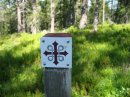
This is the second of two weeks of pilgrimage this September. I have yet to blog the first one, on the Cornish Celtic Way.

I arrived at Swarthmoor Hall on Monday, met my fellow-pilgrims, and was introduced to the week by our leaders Bill and Sylvia. Bill has been the Warden here, and reckons he has climbed Pendle Hill 16 times.
I am the only non-Quaker in the group, and most of the others seem knowledgeable about Quaker history.
Tuesday to Thursday begin with breakfast, then off in the minibus to significant places, with picnic lunch, returning in time for an evening meal and finishing the day with the Epilogue, a short meeting for worship, at 9 pm.
On Tuesday, the first stop was Clitheroe Meeting House, a modern white building which was previously a restaurant. Unfortunately my attempts to take a photo on my phone were unsuccessful. The Meeting moved there from a cold and damp building some way out of town two years ago, and have doubled their membership since then. Two members, Wendy and Ben, greeted us. Ben placed the key year of Fox’s mission to the Northwest in a social historical context, explaining the disillusion with the established church and the prevalence of Seeker groups eager to listen to what he had to say.
We drove along country roads to a track leading towards Pendle Hill, which Fox climbed on his arrival. I am a bit confused about whether his vision of a crowd of eager followers came at the summit to which he had struggled “with much ado” or in the pub afterwards. Today there is a good path like a stone staircase for the 200-metre ascent, and a wider track of rather loose stones for the descent.
Eight of us climbed the hill and had lunch followed by a 15-minute meeting for worship just below the trig point. The latter was terminated with a loud “Baa” from an intrepid sheep.
Back in the bus, we drove to Settle, where we visited the Meeting House, which was the first place of worship in Settle (the parish church being down the road in Giggleswick), and were surprised by three stuffed orangutans in the garden.
About half the group met in the Friendship Room after supper, and talked, mainly about why we had come and how we felt on the top of Pendle Hill. This went on until it was time for the Epilogue.
Wednesday was a slightly shorter day out, beginning with the Quaker graveyard and Meeting House at Briggflatts. To my amazement, three of the group were looking for particular graves: one for members of his family, one for a former l popWarden of the Meeting, and one for the Quaker poet Basil Bunting. The meeting room dates back to the 17th century, and has an exhibition of pictures and Bunting’s poems in the gallery. Alan, a Friend who has recently moved to the area, told us about George Fox’s visit to Briggflatts.

We then visited the church at Sedberg, where Fox gathered a crowd of listeners at the Hiring Fair and had an argument with the priest, before proceeding to Firbank Fell, where he preached to about a thousand people from an impressive rock. Not much walking was involved, as the site is now close to a road. Two horses tried to join us for lunch.

Then on to Kendal to visit the Quaker tapestry, a project resulting in 77 panels illustrating different aspects of Quaker life and history, which was completed in 1995. We spent an hour and a half here, and then opted to return by the “scenic route”, stopping to admire a view over Lake Windermere.

Thursday was an even shorter journey, to Lancaster where the Meeting House provided a room with tea, coffee and biscuits, and toilets, but none of the warm hospitality we had found in the smaller meeting houses of the previous days. This didn’t bother me, as we weren’t there long enough for a talk or worship, but the others were shocked and disappointed.
The purpose of going to Lancaster was to visit the castle, where George Fox and Margaret Fell (later Fox) had been imprisoned on various occasions. The castle was a prison until 2011, and houses civil and criminal courtrooms, the latter still in use. Otherwise it’s a museum – guided tours only. The tour guide was excellent, lively, informative and amusing, and a senior colleague met us at the end of the tour to answer some questions she couldn’t.
Returning to Cumbria, we visited the early burial ground where Margaret Fox and 226 other Friends are buried. No tombstones were allowed there at the time, so there is not much to see, but great views of the coast from across the road.

Returned to Swarthmore Hall at 3 pm. I filled in the half hour before tea exploring the gardens, including the labyrinth. At 4, Susie, the Quaker in Residence, led a tour of the Hall. It had passed out of the hands of Margaret’s family and allowed to decay, but bought back in 1914 by a descendent who restored it, adding woodcarving in the style of the original panels. She left the Hall to her nephew on the understanding that he would pass it on to the Quakers which he did in 1954. Interesting furniture and artefacts, some associated with Fox, others of the period.

There are some amazing colourful quilts, including this one with a central panel showing the lion and the lamb lying down together.

On the last morning, we walked to Swarthmore Meeting House, donated by George Fox in readiness for the time when Quakers could not worship at the Hall.

When the shutters to the passage and gallery are open, there is room for 120 people.
Back to the Conference Centre for our feedback and lunch before going our separate ways, Bill and Sylvia with a banner for the day’s Climate Strike in Ulverston.

 emeritablog: life after work