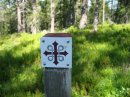
Yesterday I returned to Bétharram, about 32 years after my previous visit when I arrived here on my walk from St Jean de Luz, on the Atlantic Coast, to Lourdes, and, tired as I was, followed the way of the cross on the hillside above the sanctuary.
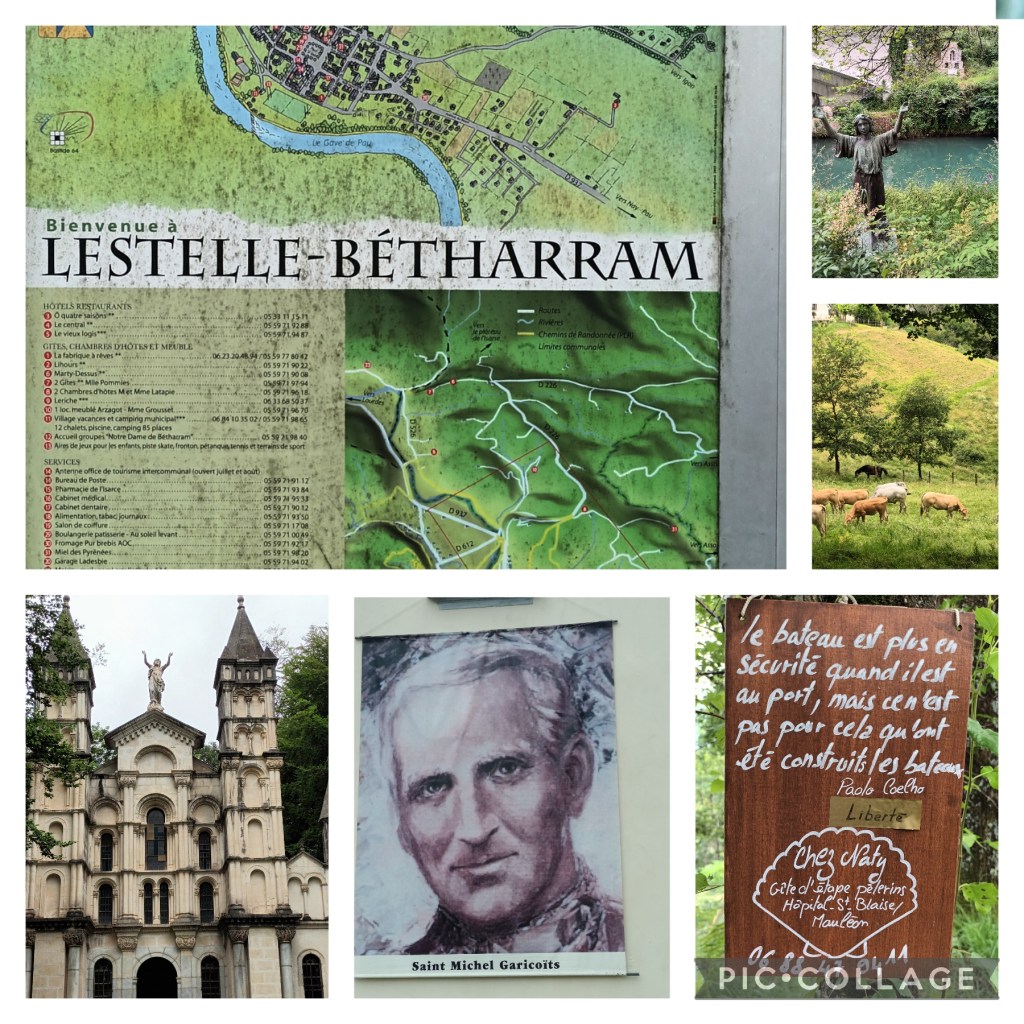
I felt, then, that I was following the trail of St Michel Garicoits, whose story I first encountered near the beginning of the walk, and whose prayer, “Me voici, Seigneur” (“Here I am, Lord”) became mine. Until, one day, I imagined hearing God reply, “You keep saying, ‘Here I am’ and then go dashing off somewhere. Can’t you keep still?'”
From a poor family, and horrified by the violence of the French Revolution, Michel vowed to become a priest. He was the Director of a Seminary in Bétharram, and I seem to remember reading that he prepared the young Bernadette for Confirmation.
I hadn’t realised that Bétharram was already well known as a pilgrim site – long before Lourdes – following the discovery of a statue by the river bank (top right, in background). The river, as on most of my other walks thus time us the Gave de Pau.
After praying for peace in the Sanctuary, I walked slowly uphill along the Way of the Cross, pausing at each of the elaborate Gothic shrines, to the Chapel of the Resurrection in the photo above, and continued beyond it on a footpath.

I passed some cows enjoying the lush grass and a sign directing walkers to a pilgrim refuge (see top photo again), and continued along a route suggested in a book of rambles in the area. Another walker overtook me with just a “Bon jour.” Not having brought any food, I stopped at a bar in the next village for a draft beer.
The route became a narrow path by a railway line, so muddy in places that my boots are on the point of disintegrating. I managed with the help of a branch picked up on one if the worst stretches, and eventually reached a main road just short of the “Bridge of the Caves”.
The Caves, discovered in the late 19th century, and electrified and opened to the public, were not actually on the route in the book, but I decided I probably had time for a detour. What is there to say about stalactites and stalagmites advancing towards each other at a centimetre per century and still a hand’s breadth apart? We descended about 80 metres to the lowest of the five levels, where the river bed was obvious, and took a boat through a tunnel for a few hundred metres and a tiny train for the remaining 3 km back to the starting point.
This gave me an hour and a quarter to wait for the bus back to Pau, or walk to the village, which I managed with time to spare. The only problem was that the terminus wasn’t where I had expected, but fortunately I walked in the right direction until I recognised where I was.
 emeritablog: life after work