Project dates February-March 2021
The challenge was to choose books set in adjacent countries, written by a native of that country or someone with a significant connection, e.g. more than one year residence. As this was sometimes difficult, I decided to read two books per country, at least one by a native or resident, and at least one set in the country.
The posts below are copied from, and link to, the Goodreads web site. Click on the book title for the name of the author and details of the book.
My trek through Eastern Europe begins in FINLAND where I read three books: by Finnish authors.
Fargoer. A clash of civilizations: hunter-gatherers, farmers, and Viking traders.
The Red King of Helsinki: Lies, Spies and Gymnastics. Spy story set in 1979, giving a picture of political sensitivities in Finland during the Cold War, and their impact on the lives of teenagers.
The Howling Miller. A richly comic novel set in and around a village in the North of Finland in the early 1950s. Finnish author.
ESTONIA: Two accounts of lived history.
Letters from Estonia: 1917 – 1926. Letters and newspaper articles from the wife of the Dutch consul, with notes by the editor, covering the Russian Revolution and the attempted coup.
Back On The Map: Adventures In Newly Independent Estonia American banker takes up a short-term post teaching accountancy in the newly-independent republic of Estonia in 1991, with an appendix following the young country up to 2009. The author lived in Estonia for 5 years.
Now for LATVIA
Up The Baltick: The rediscovered journey of James Boswell and Samuel Johnson to Esthonia, Livonia and Kurland in the year 1778.. A spoof sequel to their Hebridean journey. Kurland and Livonia, now parts of Latvia, account for three quarters of the book. The author lives in Latvia.
The Tower and Other Stories. A variety of comic and fantastic stories from 1920s rural Latvia by a Latvian author.
LITHUANIA
The Prince of Winds: 7000 Nautical Miles after the Legend of Mikołaj Krzysztof “the Orphan” Radziwiłł. Three voyages sailing in the Mediterranean, the dauntless crew waving the Lithuanian flag and furthering cultural diplomacy.
Whitehorn’s Windmill: Or, the Unusual Events Once Upon a Time in the Land of Paudruve. Folk tale meets magical realism, according to the translator.
Both by Lithuanian authors.
This completes the first section of my journey, through countries of the European Union and the Nordic and Baltic Deanery of the Church of England where I was Area Dean from 2012 to 2015, based in Sweden and visiting Finland, Latvia and Estonia as well as the Scandinavian countries.
BELARUS
So Incredibly Far Away. From the protest movement in Belarus, her friends end up in hospital or prison, while Svetlana escapes to marriage in Spain. I have not been able to verify that the author grew up in Belarus.
Burning Lights. Bella Chagall’s account of her childhood in an Orthodox Jewish family in Vitebsk, with all the rituals of Sabbaths and High Holy Days. Line drawings by her husband Mark Chagall.
UKRAINE
Baba Dunja’s Last Love. A story of Chernobyl survivors. Author born in Russia, now living in Germany.
The Seventeenth Floor: a story of a husband who loved his wife but dreamed of other women. Set in Dnepropetrovsk, an unexpectedly light story about AIDS. Ukrainian author.
MOLDOVA
I matched the memoirs of an Englishman living in Moldova and a Moldovan living in England: very different stories, very different books. All they have in common is an early devotion to sport, and made their moves at a similar age.
Missionary, Me?. College footballer Matthew volunteered with a missionary organization to impress his girlfriend. They had been in Moldova for 17 years at time of writing.
No One’s Business: A Migrant’s Barefoot Journey to Millions. Judo star left Moldova and made his way to England as an illegal immigrant. He is now a successful businessman. This is a self-help book with suggestions for further readings (“If I can be a success, so can you!”). There is some information about his childhood and youth in Moldova, rather more about his adventures on the way through Austria and Italy, but I would have liked to know how he managed to legitimize his status in the UK – presumably he has done so?
ROMANIA
Bottled Goods, The heroine escapes from Ceausescu’s Romania and her mother and aunt; but it is many years before she is really free.
A Shout behind the Iron Bars. The narrator knows all about terrorism, from his work in a counter-terrorism unit – until one day he himself is arrested on the charge of terrorism. The early part of the book is reminiscent of The Trial.
Both authors were born in Romania.
BULGARIA
Two books with some common ground:
Queen of Cucumbers covers more than a century of Romanian history through five strong women in one family. The story begins as a soldier returns from the Russo-Turkish War of 1877 in time to toast a birth in a Bulgarian village, and ends with another birth, in England, after the Brexit referendum. The first novel of a Bulgarian author.
Street Without a Name: Childhood and Other Misadventures in Bulgaria is a memoir of youth in communist Sofia, emigration in 1990, and return 14 years later to explore the country that is still the writer’s homeland in spite of everything.
BELARUS TO BULGARIA: Belarus – Ukraine – Moldova – Romania – Bulgaria
NORTH MACEDONIA
The Time of the Goats. A delightful story about what happens when the government tries to turn rural peasants into an urban working class: they bring their goats with them. The author describes himself on Facebook as “an Albanian writer from the Republic of Macedonia.”
To the Lake: A Balkan Journey of War and Peace. The author of one of my choices for Bulgaria, Street Without a Name: Childhood and Other Misadventures in Bulgaria, revisits her grandmother’s home by Lake Ohrid, and the surrounding countryside, with excursions into Albania and Greece.
GREECE
Uncle Petros and Goldbach’s Conjecture: A Novel of Mathematical Obsession. As a young Greek mathematician, Petros became obsessed by an unsolved problem in number theory. He had the opportunity to work alongside leading scholars in Cambridge. And then everything went wrong. His story begins and ends in Athens, where the author lives.
The Theban Plays . Probably the earliest work I shall read on this trip, the original dating from the fifth century BC and the physical book (Penguin Classics translation) from 1947. I saw a school production of King Oedipus about 60 years ago, know the story of Antigone from Jean Anouilh’s (significantly different) version, and was reminded of its classic status by Amanda Cross’s detective story. The Theban Mysteries, but the third play, Oedipus at Colonus, was new to me, as was the lyrical force of the songs of the Chorus.
ALBANIA
Two novels by Albanian authors about Albanian women.
Flutura (Hope Is Alive: A Story of Love and Destiny, mid-20th century) is a good girl, faithful to Islam, family, and friends, courageous and resilient to all that fortune throws at her, carefully polite to those who insult her, ending the conversation with “We understand each other.” Her naivety and the abrupt suggestion of a happy ending left me feeling uneasy.
Sara (Nowhere Girls, 21st century) has two friends from her student days, whose names make an anagram of Albania: the successful and corrupt Alba and the battered wife and mother Ina.
KOSOVO
Edith and I: On the trail of an Edwardian traveller in Kosovo. When her husband was working in Kosovo from 1993 to 1995, Elizabeth Gowing had many questions about the country and the way of life. Three times she met the response: “Who do you think you are, Edith Durham?” But who was that mysterious Englishwoman, still remembered almost a century after her visits to Kosovo? Back in England, and then returning to Kosovo in the following decade, Elizabeth made it her job to find out.
Summer Is My Favorite Season: A Memoir of Childhood and War in Kosovo. The author’s memories of life in Kosovo as a small boy, and then as a teenager in the midst of bombing raids. A moving story.
MONTENEGRO
Both books are set in post-Communist Montenegro; one of them refers to the country’s celebration of independence.
Milena: & Other Social Reforms is a story of the corruption (sex, drugs, violence, deception) hidden behind the heroine’s appointment as Co-ordinator of Social Reforms, which pursues her even after she has left the country and is working an a nanny in London.
The Son is a novella about a night of misery; his mother died unable to bear his presence, his wife left him, and the family olive grove is going up in flames for the third time. Can any good come out of this?
SERBIA
Camara oculta/ Hidden Camera. A mysterious envelope sets the hero off on a quest through the streets of the (unnamed) city, into more and more bizarre situations which he can only explain to himself as filming for a reality TV show. Fantasy or philosophy? Serbian author.
With Their Backs to the World: Portraits from Serbia. Asne Seierstad, working as a war correspondent for Norwegian broadcasting, interviewed 14 Serbians – young and old, poor and rich, peasants and politicians, and wrote the first edition of this book. The next year, she came back, to visit these friends. Three years later, after the war, she returned, and interviewed them a third time. This is the third edition.
BOSNIA AND HERZEGOVINA
A Currency for the Cat: Travels in Bosnia and Herzegovina. From the title, I expected something more lighthearted. There are no cats in the story, and the only currency issue is a problem about paying a Serbian bus driver in Bosnian money. The author, still grieving for his sister who died in childhood more than a decade ago, travels from his home in Wales to seek relief in his visits to memorials of wars and genocide. reconstructions of mighty stone bridges from Ottoman times, and bus journeys through beautiful countryside.
My Heart Will Triumph. Mirjana Soldo was one of the children who received visions of the Blessed Virgin Mary in the small village of Medjugorje in Herzegovina in 1981. This is her autobiography. Returning to Sarajevo for the new school year, she was harrassed, persecuted, and expelled from school, only able to continue her education at a special school for drug addicts and other dropouts. There is a moving account of how her quiet presence led her schoolmates to confide in her and ask about her faith. Some chapters are a bit preachy, but on the whole, it’s a story of an ordinary girl/woman formed by extraordinary experiences.
CROATIA
Both books are by Croatian authors and partly set around the river Sava, but from different eras and perspectives.
Voices in the Forest: A Coming-of-Age Story about a Mischievous Boy from Croatia. Excluded from school in the 1960s after throwing an inkwell at a cruel teacher, George runs wild in the forest, with help from two accomplices, graduating from stealing cherries to throwing rocks at a French diplomat’s car (which makes him a hero!) and other more serious crime. He returns from three years in prison equipped with skills useful in guerrilla warfare.
Searching for Huck in Balkans: 700km down the Sava River on a wooden raft, through Croatia, Bosnia and Serbia. Vladimir Dopuda’s childhood may be far behind him, but the books he read, about Tom Sawyer, Huckleberry Finn, and messing about on a river, have remained with him. He comes up with the idea of drifting, sailing, and occasionally motoring in a homemade raft down the river Sava from Zagreb to Belgrade where it joins the Danube. The most complicated part of the journey was satisfying the Croatian and Serbian officials on either side of the border.
SLOVENIA
White and Red Cherries: A Slovenian Civil War Novel. Martin and Anna were born in the closing years of World War II and brought up as brother and sister. Only on the deathbed of her mother, Valeria, in 1991 does Anna discover that she is the daughter of a murderer (the wartime Liberation Front), and Martin, that he is the son of a traitor (the Home Guard). Both did what they thought right in difficult times, and the children, pushing 70, speak out at a truth and reconciliation meeting in Slovenia, still war-scarred and divided.
Slovenian Grandma’s Kitchen: Children of Slovenian elementary schools revive their culinary – cultural heritage is the result of a project in Slovenia’s elementary schools, to discover and recreate traditional recipes (some of which are mentioned in White and Red Cherries: A Slovenian Civil War Novel). Delightful colour photographs. The lists of ingredients were interesting: carbohydrate-heavy food with many different kinds of flour for farmworkers, walnuts, honey, and pork crackling for flavouring, dandelions when in season. A short note for each recipe says something about its history, geography, or special occasion when the food was eaten. Unfortunately the font reproduces badly on both Kindle and tablet, so that the words run in to each other.
Countries visited in the BALKAN JOURNEY: North Macedonia – Greece – Albania – Kosovo – Montenegro – Serbia – Bosnia – Croatia – Slovenia
AUSTRIA
Der Schwierige – The Difficult Gentleman. I remember seeing this play many years ago, and reading the book confirmed my impression that most of the characters are much more “difficult” than the central one in this upper-class comedy from 1921.
The Empress and the Cake. A crazy old woman, obsessed with the life and possessions of the late Empress Elizabeth, entraps the narrator, whose name is never mentioned: a young woman suffering from an eating disorder and a broken relationship, into living out the fantasy. Not a comfortable read.
Both are by Austrian authors and set in Vienna.
HUNGARY
Apricot Dumplings: A Guided Tour around my Home. A mixture of autobiography and family saga, the latter going back to the early twentieth century. I hadn’t realized that Transylvania used to be part of Hungary; when it was ceded to Romania, her grandfather’s university relocated in order to remain in Hungary.
The Gresham Symphony. A girl of 20 arrives in Budapest, naive, excited, and eager to fall in love “for the third time” in the 1970s, era of “goulash communism”. Conspiracy and fate get in the way.
Both authors were born in Hungary.
SLOVAKIA
Fleeting Snow. A story of ageing, dementia, loneliness, philosophy, memory, and imaginary friends, with references to the Tatras mountains and Slovak philology.
For the Dignified Dead. An international investigation of financial crime and murder, with Commander Jana Matinova of the Slovak police as central character. The author has worked for the US Department of Justice in Central Europe.
CZECH REPUBLIC
Prague Mysteries: Crime Stories by Czech Authors. 18 short stories by nineteenth and twentieth century authors including Franz Kafka, not all of which have crime as a central theme.
The Memorandum. Vaclav Havel, playwright, dissident, and the first President of the Czech Republic took as his theme chaos in the office following impractical reform: in this case, insistence that all memoranda should be written in a new invented language. Again (see the previous post), philology plays a part.
POLAND
Two books by Polish authors set in medical institutions.
Mrs Mohr Goes Missing is set in a home for the elderly in Cracow near the end of the 19th century. A most unlikely detective solves the problems of disappearance and murder, and is rewarded by having a telephone installed.
Hela: A Novel of Science, Faith, Love and Poland is set in a former stately home transformed into a medical research institute, where the heroine signs up for research in order to pay a hospital bill and gets more than she bargained for.
This is the last country of my backpacker trip in Eastern Europe. It remains to take a Baltic cruiser back to Finland where the journey started.
FINLAND
I read one more book from Finland to round off the journey where I started.
The Girl and the Bomb tells of conflict between a gang of graffiti artists and a security service. Set in Finland with a closing episode in Chernobyl.
The final section of my journey: AUSTRIA – HUNGARY – SLOVAKIA – CZECH REPUBLIC – POLAND – FINLAND
Barbara’s Backpacking Trek of Eastern Europe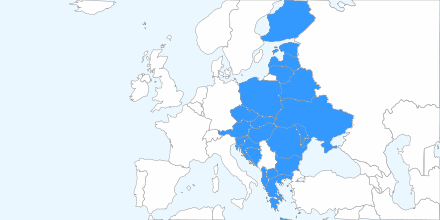
Make yours @ BigHugeLabs.com
The blank space on the Balkans is Kosovo. I “visited” it, but it is not included in the list of countries with the mapping app.
 emeritablog: life after work