Pilgrim Priest
24 September 2018
On Wednesday I shall take off for Santiago to join the Camino Chaplaincy based at Egeria House. I met several Pilgrim Priests in Scandinavia: Lennart who led the walk on the Dag Hammarskjöld Way from Abisko to Nikkaluokta in Lapland; Elizabeth from the Norwegian border to Nidaros (the ancient name for Trondheim); and of course Hans-Erik Lindström, the doyen of Vadstena Pilgrim Centre and his successors. As a priest who is also a pilgrim, I longed to be able to call myself a Pilgrim Priest, while doubting that I could live up to the ideal of The Servant Song:
“I will hold the Christ-light for you
in the night-time of your fear;
I will hold my hand out to you,
speak the peace you long to hear.”
Now I have the chance to be part of a new seasonal chaplaincy, based in Santiago for a few weeks this year, and possibly as a walking pilgrim in 2019. I shall also take some time off between the weeks there to follow my own pilgrimage along one of the less travelled routes, walking from Toledo to Avila with my cousin Gordon Flowerdew.
26 September to 5 October: in Santiago
(26/9) I arrived at Egeria House just before 5 pm, in time for the Wednesday Eucharist and evening meal. Some local friends of the chaplaincy were there, but left before the service. Then we were joined by two pilgrims, sisters, from Australia, one of them a school librarian. Brian, who has been the chaplain here for the last 10 days or so, led the service, and we sang Taizé chants. A large group of Americans had been expected, but didn’t turn up and sent an email later that evening: frustrating, as chairs and stools had been borrowed to accommodate them, and plenty of food prepared. Brian and his wife Di are staying in Air B&B, so it’s just Sybille and myself, and Esti, a kitten rescued by a pilgrim which Sybille is looking after, in the house for the first few days.
(27/9) Sybille and I said Morning Prayer together before carrying eight stools back to the Cathedral, which we entered through the exit door to reduce the distance. The English Mass is in a small chapel near the exit, with seats for about 40. Today there was a large group of Americans, very traditionalist, who had taken over the chapel and were saying the Rosary when we arrived. Fr Noel, the volunteer priest from Australia, with whom we had coffee afterwards, thought this was a bit much.
I was sitting by a stone tomb of a bishop, or, to be more precise, by the lion at his feet. The chapel is dominated by a statue of Our Lady in voluminous black robes, with the seven swords piercing her heart, surrounded by putti angels with broken limbs – a missing arm, a missing foot – and grumpy expressions on their faces. Jesus seemed absent – until, going up for a blessing at communion, I saw a fresco Pieta on the side wall.

The 10:00 English language Mass was made more intimate by one of the sisters volunteering with Camino Companions inviting everyone to say their name, country, and where they had walked from. Members of the congregation were also invited to come up, light a candle and say a prayer. Since Sybille and I were identified with the Anglican Chaplaincy, we did not receive communion but went up for a blessing. Never had a blessing felt so comfortable, encouraging, and affirming of my own ministry.
Fr Noel’s sermon mentioned a book by a Jesuit pilgrim who walked to Santiago after the death of his brother. I had read that one.
Sybille is very hospitable, keeping the kitchen stocked up and cooking the evening meal Leftovers from Wednesday’s absent guests will be plenty for today and tomorrow. and let us know when she would be doing the washing. About the only job I undertook was emptying the dishwasher; filling it is a highly skilled job. I bought some softer bread, mandarins and orange juice for breakfasts. and such lunches as I had there.
That afternoon, two pilgrims turned up at Open House, though not at the same time. One of them had strong views on those who report on or send photos of people they met on the camino on social media. This made me rethink my plans for blogging and posting. I also met the “cat daddy”, Mike, who had rescued Esti, who dropped in to discuss how to transport Esti to their home in California. She cannot travel back with them because they are flying back via the UK, and the kitten is too small to have the injections and chip implant needed to satisfy UK rules, so will stay with Sybille until November.
Everyone had left before I thought about evening prayer, or I might have suggested a short service of blessing the light, of which Brian had brought photocopies. Instead, Sybille and I said Evening Prayer in full after they had gone.
~~~~~~~~
Most days I lunched in town, hoping to meet pilgrims and get into discussion with them. I found this “pilgrim-hunting” difficult; the cafes could be either too full or too empty, lone pilgrims were sometimes engrossed in their mobile phones and couples in conversations I was loath to interrupt. But wandering round, I came to get the feel of the place, the destination to which so many had walked so far, and to accept that being there was important in itself. Sometimes there was an opportunity to chat after the Mass to pilgrims, either (quietly!) in the cathedral, or seeing them around the town. I recruited several Norwegians for our Open House and Eucharists in this way.
Sometimes I would call in on our fellow pilgrim-welcomers: the Camino Companions, usually RC priests and nuns, who have an office in the Pilgrim Centre alongside French, German, Dutch and maybe other welcome centres; and the volunteers at Pilgrim House on Rua Nova which provides a range of practical services: somewhere to leave rucksacks, WiFi , printing boarding cards, and space to chill out as well as “debriefing” for the end of a pilgrimage.
(28/9) The alarm woke me at 8, but I took my time about getting up and forgot about Morning Prayer until it was time to leave for the Cathedral. Today there were many pilgrims from Ireland, and a coachload of Filippinos. I talked to a woman from Sweden – RC but working for Svenskakyrkan, Diocese of Harnosand. She took a leaflet to show her colleague. I was surprised that she didn’t seem to know about St Birgitta, but she did recognize the Olaf badge on my hat. I wandered around town getting lost, and eventually found the Pilgrim House on Rua Nova, where I spent an hour on Wifi, dealing with email, checking Facebook, and doing a Spanish lesson on Duolingo.
No visitors at Open House today. Sybille and I said Evening Prayer together at 17:30.
The “cat parents” – Mike, who had rescued Esti and his wife – took Sybille and me out to dinner. We shared a salad between four of us, and starters and main courses between two, then two of us had dessert and the other two coffee. The grilled vegetables were lovely, but I struggled a bit with the paella. I am unlikely to eat at this level again on this pilgrimage.
(29/9) We said Morning Prayer separately this morning, Sybille using a Spanish RC app. My lectionary came up with the execution of St James. We went together to the Parador so that I could see the room in preparation for tomorrow’s Eucharist. Then I went to the Pilgrimage Museum, free to pensioners. The ground floor included a multi-faith database where I found the Kumano Kodo and St Cuthbert’s Way, but nothing about Avila. Also an animated filmstrip showing, among other things, a medieval pilgrim burying her companion. The top level had a video conversation between the architect Master Mateo and his pupil about the history of the cathedral building – a bit childish but quite informative. There was also stand with headphones where you could listen to medieval instruments and pilgrim songs.
There is no Open House today (though we did have a pilgrim referred to us by the Camino Chaplains who joined us for some meals over the weekend). At about 16:30 I headed for the squares around the cathedral to chat to pilgrims and, if appropriate, tell them about tomorrow’s eucharist. The two Australians who had visited us earlier in the week were there, following their trip to Finisterre.
(30/9) Eucharist at the Parador with 9 pilgrims from England, Germany, Norway and New Zealand, and songs from Sweden, Ireland and South Africa. I scrapped my prepared sermon in favour of some impromptu comments on some phrases from the gospel (“he was not one of us” and “live at peace with one another”) in the context of the camino.
The hotel (Hostal de Reyes Catolicos, to give it the proper name) was originally built as a hospital for pilgrims, and continues its commitment to the pilgrim cause by providing free lunches for the first ten arrivals at the Pilgrim Office each day, and letting us have free use of a room for the Eucharist. This is the original apothecary’s office, and there were a dozen chairs which we rearranged into an arc around the table which served as our altar. Church coffee was in the hotel bar.
After lunch, I tried to follow a walk to Ganas, the “city of culture”, but got lost and took a main road passing the bus station back to the centre, stopping for a glass of sangria on the Rua San Pedro.
This evening was, I think, the first time that I used Sybille’s phone as a hot spot to connect to the Internet. I did this to respond to a query from Bob, who will join us on Wednesday. Also worked through a module of the Spanish course on Babbel. Although in theory it is possible to download lessons, the sound doesn’t work properly offline.
(1/10) In spite of having agreed to say Morning Prayer separately, we said it together this morning, as we were both ready to do so at the same time. I did cut short the very long Old Testament reading about Naaman the leper, stopping after my favourite verse: “If he had asked you to do something difficult, you would have done it.” (One pilgrim, on hearing about my proposal to walk on the Camino de Levante, asked if I had always been a contrarian. Probably.)
Fr Noel’s sermon today mentioned a book called Sinning across Spain, by an Australian woman who was intrigued by the medieval custom of paying a pilgrim to walk off the donor’s sins and obtained sponsorship for a pilgrimage of her own. I was able to get it on Kindle – a good read!
After the Mass I talked to an English couple living near Gothenburg who had sometimes come to St Andrew’s in my time and knew several of my Gothenburg friends.
Then I visited the Camino Companions at the Pilgrim Centre. I had a long chat with one of them, Gloria, who offered massage to aching feet and stiff shoulders. Her colleague came in and said someone had booked a massage for 1:10, not one of the slots available. The mystery was cleared up when she said “It says ‘lunes 1 10′” i.e. Monday 1 October!
Lunch was the cheapest restaurant menu in Santiago, the Medical School cafeteria: 5.90€ for lentil soup, chicken and chips, chocolate mousse, bread and mineral water.
One visitor to Open House, a pilgrim who had borrowed walking poles was returning them.
(2/10) Again we said Morning Prayer together. The Mass was taken by Father Manuel (Mani), a Filippino priest working in the cathedral. He gives quite long blessings, and a lot of people received them. Three of them – two Norwegians, one Englishwoman – came to Open House in the afternoon, as did a pilgrim who had visited on his way to Finisterre and was back again. We had a short evening service (Blessing of Light + Taize chants) before the first three left.
Esti dug her claws into my arm, and drew blood. Apparently this was my fault for moving when she ran over me. Sybille immediately sprayed the wound with disinfectant and bandaged it. Probably I wouldn’t have bothered.
(3/10) Bob arrived on Wednesday 3 October, in time for the eucharist which I took as a Pilgrim Mass. It was the Vigil of St Francis, so I spoke about ways in which Francis built the church which are still relevant today. Bob was the Area Dean of Portugal before he retired. His presence allowed me to take next week off for my own pilgrimage walk.
(4/10)Since it is St Francis Day, Fr Mani took us to St Francis Church after Mass.
Sybille and I had decided it would be appropriate to have a pet blessing for Esti on St Francis’ Day, and asked Bob if he could dig out some suitable liturgy. Sure enough, he turned up with some booklets for a Pet Blessing service. a kitten Sybille was fostering until the pilgrim who had reached her on the Camino could arrange to take her to California.
(6/10) Left the house early to catch the 7:00 bus to the airport. On the bus, I talked to a pilgrim who would be glad to get out of Spain, having been attacked by bedbugs three times of the Camino.
6 to 14 October: Toledo to Avila
6 October: Toledo
This is where beginneth my Camino of 2018.
Toledo was the site of the fifth convent founded by St Teresa, 450 years ago. There will be a special concert in her honour in the cathedral on October 19, but we shall have gone our separate ways by then, Gordon to stay with a friend in Malaga and I to return to the pilgrim ministry in Santiago.
The train I meant to get from Madrid was full, so Gordon reached the hostel an hour and a half before me. Our only sightseeing together was the Cathedral, where we spent an hour waiting for the market to reopen after the siesta, and later returned for Mass.
It gives the impression of a lot of separate spaces. Even the sanctuary is separated from the choir, with empty space between the two. The sacristies have been converted into an art gallery, with a set of El Greco portraits of the apostles. Most of the chapels were closed by iron gates, and the one where the Mass was celebrated was in three parts: a fenced-off area within the main cathedral space with its own street entrance for worshippers only; then through the glass doors to a quieter space for prayer; and finally, heavy iron gates can be opened to give access to the final chapel with a double row of pews on each side (and decent kneelers)!
There was plenty to see: much golden baroque, the carvings on the sedillas in the choir, and a huge mural painting of St Cristobal (Christopher) carrying the Christ child. Of course there was a chapel of St James. But, to my joy there was also one of St Teresa.


7 October: Toledo to Torrijos
We left the Youth Hostel at 8 after a basic breakfast of one cup of weak coffee and a bun, and immediately met the only pilgrims we would encounter in the week: an Italian couple who had been walking on the Via de la Plata and were on their way home. There were no waymarks on our way out of Toledo, and it was thanks to a helpful cyclist that we found the first one at the beginning of the Camino de Albarreal, a wide dirt track and a welcome relief from the main roads.
The map in the guidebook showed no major roads for the first 24 km, but we were seldom far away from the N 403 and the nearby motorway A40! This made it difficult to identify how far we had come in the route description. Only when we crossed the Rio Guadarrama (16 km) did I think I knew where we were, so we stopped for lunch and Morning Prayer out of the St Teresa Prayer Book I had downloaded onto both my tablet and my Kindle. But the next bit of the description did not fit, and we ended up on the side of the N 403 into the village of Rielves, where we failed to find the bar. However, we had better luck in the next village, Barcience, and refreshed ourselves for what we thought would be an easy final stretch into Torrijos.
The guidebook suggested the Calle de los Jardines, but this had no waymarks, and petered out at the junction of several unnamed dirt tracks. So we took the Calle de Torrijos, which at least had some tiles with the Camino logo of the cockleshell on two of the houses, and, I think, some yellow arrows. But these, too, became scarce, and we reached a T junction of tracks just before the motorway, with no indication of how to get across. Eventually we found an unmarked footpath leading to two unmarked concrete tunnels, the second of which took us via another footpath to the sliproad which passed under the motorway to an industrial estate, where I was able to ask the way at a garage – or rather, to ask where we were, on a street map posted outside it. Just turn right and keep straight on to our hotel. We had propably walked about 35 km to allow 1 km for wandering around looking for a way to cross the motorway, which had been the most tiring part of the day.
A friendly receptionist, who spoke good English but warned us that her colleagues did not, and an evening meal in the hotel as soon as we were ready for it (rather than having to wait till 8 pm or later) helped to restore our spirits.
8 October: Torrijos to Escalona / Almorox
We could have followed the A 403 all the way, but thankfully we did not have to. We were never far away from it, though, until we reached Maqueda (12.5 km), a small town with a castle and, more to the point, a bar for lunch. On the outskirts, our path diverged from the road for a peaceful 12 km to Escalona, which we reached just as the first cafe was closing for the siesta. Another one, further along, was able to provide refreshment. However, I was worried that the address I had for the night’s accommodation said it was at the 68.8 km marker (distance from Toledo) on the A 403, and we had only reached the 52 km marker. This suggested it was a lot further than Almorox, and Gordon asked the barman to ring for a taxi. The driver was surprised, since it was such a short distance – it really was in Almorox, and more like 62 than 69 km from Toledo. He only charged us 10€. I was disappointed not to have walked it, but the day was hot, and we were both tired.
After washing our clothes, we explored the town, bought some food, and looked for a restaurant, but they were closed on Mondays so we ate in the bar where we were staying – noisy and busy, but perfectly adequate.
9 October: The Old Cattle Road
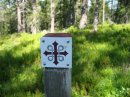
After two days of frequent encounters with the main road N403, yesterday was delightful. For much of the time we were following Via Pecuria, which, judging from its logo, was an old drovers’ road, and is still used for taking cattle to summer pastures – we saw the evidence, but not the cows.

We walked through woodland, and up the Hill of Three Crosses, where we stopped for lunch. I hoped to see three crosses at the top, but there weren’t any. The Camino goes down a steep firebreak, but we followed the alternative suggested in the guidebook, a wide bumpy drovers’ road. If the roads were like this, or worse, in Teresa’s day, I understand why her coach journey from Escalona to Avila was uncomfortable.
Much cooler today – clouds, wind, altitude as well as plenty of shade from the trees and some enormous rocks.
We had booked a self-catering apartment in San Martin de Valdeiglesias for 80 euros (very nice apartment, would have suited a family of four, but nobody at the reception desk and we had to try to attract the attention of someone at the busy bar to check in), and saved some of that by making our own dinner. As we were finishing at 6:30, we heard church bells and guessed there might be a Mass at 7. We got there in time. Large congregation for a weekday, and very enthusiastic Spanish priest preaching about Mary and Martha. I wish I understood more Spanish.
10 October: San Martin to Cebreros
We resisted the blandishments in the guidebook (“It would be a pity to pass this way and not see los Toros de Guisando”) and bypassed the Celtic stone sculptures to stay on the N 403 (again!) out of San Martin – boring, but shorter and quicker. When we came to the turning, I noticed that it was waymarked not only as a Santiago camino but also a Teresian one. Also that cyclists were directed to stay on the N 403 a bit longer – the path was narrow in places. The hill we passed – presumably Mount Atalaya, 810 m high – was wrapped in mist. It was a pleasant path, and took us past three shepherds with four dogs and a flock of sheep. We stopped for lunch at the bottom of the hill, and saw them coming back down, before crossing the first of three medieval bridges. When we came to another road, we found green waymarks pointing through an open gate. This led to the chapel of the Virgen de Valsordo, a place of local pilgrimage. The chapel was locked, but we sat on a wall outside and said both Morning and Evening Prayer.
Coming into Cerberos at siesta time, we had to ask the way to our hotel, and got the answer “arriba, arriba, arriba” (up, up, up). It had bee advertized as a 4* hotel, but I think it was a training school for hotel staff. The young receptionist spoke no English and assumed we wanted to stay at the pilgrim hostel down the road. We would have done had we known it existed; but, as I had to explain to her in Spanish, because we had booked into the hotel we would have to pay for it whether we stayed there or not. We could not eat there as the restaurant was only open at weekends and breakfast not served until 9:00, so I went down to the town to buy food.
11-12 October: The last two days to Avila
Both days have involved walking up steep hills to a named pass where the Camino crosses the road, and walking through a herd of cows. Yesterday in the rain, today in sunshine with the wind at our backs.
Gordon did not want to walk back down into the town before climbing out of it again, but preferred a short cut along roads. So we parted outside the hotel, having arranged to meet at the pass where road and camino met, the Puerto de Arrebatacapas (“the pass where capes are blown off”). The walk out of town was steep but delightful, with the joy of seeing how far I had come. The pass was not windy, but cold and wet. I wondered how long I would have to wait, knowing that Gordon had actually set off on the wrong road, and amused myself by spelling out his name in stones. I was wondering about leaving a note, when I heard footsteps and saw him coming up the path. It was just as well we were together for the next bit, as some of the arrows were difficult to spot.
The last few km into San Bartolome de Pinares seemed to go on and on and on, zigzagging down a steep hill between boulders, until at last we saw the village below us.
Last night was the only occasion we stayed in a pilgrim refuge – in this case, a room with six bunks in a building also used as a health centre and for a fitness class, in the village St Bartolomé de Pinares. (Unlike yesterday, the location was described as “abajo, abajo, abajo” (down, down, down) and I was grateful to a local woman who showed me the way.) I saw from the guestbook that it was well used; two people had stayed each of the two preceding nights. We ate a variety of tapas etc. in the village, and went to church – a very large church for such a small place and not a Mass, but recitation of the Rosary.
Today we arrived in Avila, our destination, where we shall stay two nights. The walk began at sunrise, climbing out of the village. I had hoped for a shop or bar in the next village, but didn’t see one. We then had another climb similar to the previous day, which according to the guidebook saves a good 2 km over following the road, before descending to Tornadizos de Avila, where we did find a bar – open, but empty! It turned out that everyone was in the garden next door. There remained another 8 or 9 km, on the flat, at 1100 metres above sea level. Toledo, where we started, was a little over 500 m.

I thought that the bridge would bring us directly into the old city, but we were not even on the town map. We soon found a grassy traffic island with interesting but unlabelled ruins, and bus stops but no street names. At this point, a Spaniard stopped his car, and insisted in Spanish that it was too far for us to walk, and that he would take us the rest of the way. He would not take no for an answer. I asked if he knew the road our hotel was on, and so he took us there, detouring to the viewpoint at Los Cuatro Postes in the mistaken belief that we would want to take photos.
The friendly guy in the hotel – I think he was the owner – gave us a map showing the bus and railway stations as well as the city centre, and suggested some economical cafes nearby. We went to one, slightly more upmarket, by the bridge connecting us to the old town, and had a couple of drinks and three tapas apiece, for a very reasonable sum.
13-14 October: Avila: the end and the beginning

The day began well. Breakfast, with orange juice and ample coffee. The landlord had put on a DVD showing the sights of Avila, and it was a lovely morning for sightseeing, sunny but cool. We walked over the bridge, along the wall, and through the old town, and found our way to the cathedral, arriving just before 10 when it opened. Being among the first visitors, we found it a quiet and peaceful place, unlike Toledo the previous Saturday afternoon. I prayed my way round the cloisters, and then got lost in the museum and had to ask for the way out back into the cathedral.
Then to the tourist office for a better map, and along the wall to the church at St Teresa’s birthplace. A side aisle leads to a room with the bed she was born in. We discovered that there would be a Pilgrim Mass at 13:00, and went back to the cathedral plaza to look for souvenirs. I found a fridge magnet with the words of Teresa’s prayer Nada te turbe, so that I can sing the Taizé chant without lapsing into Swedish, and a small icon of Teresa, and Gordon bought the DVD we had seen at breakfast.
On the way back for the mass, we visited an interpretation centre with displays about mysticism. Although everything was in Spanish apart from an introductory guidebook at the front desk, there were striking visual images, and it was fun working out what they meant: a large, rough net; a tree hanging upside down, with bare branches on the lowest floor and ribbons with the names of mystical philosophers one floor up. We never did find the roots of the tree.
We joined the queue waiting to enter the church for the mass. Someone was singing (probably recorded) a different setting of Nada te turbe until the priests entered, and we were given prayer cards for a prayer to be said together after communion. It was wonderful to be part of a large worshipping community.
Then lunch outside a hotel on the city wall. The Menu del Dia was only available Monday to Friday, so we shared Gordon’s choice, a salad with goat cheese and quince dressing, and mine, white beans and pork. Then Gordon went back to the hotel, and I visited the Basilica of St Vincent

then Teresa’s two convents, the Incarnation and San José, when they opened for the afternoon at 16:00.

They were both outside the old city, and I hurried back to meet Gordon at the place where Teresa and a little brother were retrieved by their uncle when, as small children, they ran away to fight the Moors. This is close to our hotel, where we returned before seeking a supermarket for our journeys tomorrow and a restaurant for more tapas. Then a final Teresian evening prayer, and packing.

Gordon left for the bus station at 7 this morning. I shall go to the 11:00 mass at the cathedral, and have booked an afternoon train to Madrid and checked in to my flight to Santiago.
15 to 23 October: back in Santiago. I did not keep a diary this week, and am writing this on 5 November, so the details are a bit hazy. Some days we had visitors to Open House, some days we did not. Sometimes the chapel was full to overflowing for the English Mass, sometimes just fullish. It was cooler than in my first week, and I wore my jersey most of the time, not having packed a jacket other than a pocket anorak. When I got a Wifi link to myself, I tried to finish as many Duolingo lessons as possible; I didn’t want to do this when others are around because some of the exercises involve listening. However, I did discover that I could use the hot spot in my bedroom!
(15/10) After my week on pilgrimage, it felt strange not being able to receive communion; but we have agreed that in Santiago our primary identity is Anglican. On the other hand, it was good to be able to say where I had walked during the round of introductions. In the afternoon I visited the Camino Companions for their debriefing session. What was on my mind was that I had not walked all the way from Toledo to Avila, but had taken a taxi from Escalona to Almorox and accepted a lift for the last few km into Avila; but by the time I got to the session, I had decided not to give myself a hard time about this. I remembered what an Italian pilgrim had told me last year: “When you allow someone to help you on your pilgrimage, you are giving them a blessing.”
(16/10) I think this was the day I visited the Holy Land Museum in St Francis Church. The church is lovely, blissfully quiet after the cathedral, with posters illustrating the Canticle of the Sun (I think there was a photo competition) and Franciscan associations with the Santiago pilgrimage route. The museum was disappointing.
(17/10) We agreed that Bob would preach at the eucharist, as he had prepared a sermon about St Luke, and I would celebrate. So it was another Pilgrims’ Mass. Two of the pilgrims got lost on the way, and arrived, dripping wet, just as we were about to begin. The meal was lively, and much appreciated; all the main course was eaten!
(18/10) I went with Sybille to the Jesuit church for 19:00 Mass to celebrate the canonization of Oscar Romero. There was a service sheet with the words of the chants, and I gathered that some of the music had been specially composed by a friend of Sybille’s. A small congregation in a large church.
(19/10) As this was Bob’s last night, he and I took Sybille out to dinner at a small restaurant which did a 10€ pilgrim menu all day. As well as being cheaper, this suited us better than the late dining hours of the more upmarket restaurants.
(20/10) After Bob had left for the bus station, I walked 20 km along the route to Finisterre as far as a town with a bus service to Santiago. Passed about 20 pilgrims on the way, but the only ones I had a long conversation with were an Irishman and a New Zealander with whom I walked the last couple of km into the town. I only saw two, or possiby three, pilgrims walking back from Finisterre; most walk there and take a bus back. While waiting for the bus, I talked to a Spanish woman who had also walked from Santiago. She spoke good English and had often visited Ireland for dance festivals.
(21/10) Eucharist at the Parador, which was in the upper chapel today as the usual room was booked. 9 of us round a big round table. The gospel was about James and John asking Jesus for places of honour. I reflected on the legend of James as a pilgrim, depressed by the lack of response in Spain, being encouraged by a vision of Mary, and linked that to the times on our own pilgrimages when we need words of encouragement.
My friend Ursula arrived in the afternoon, having walked from St Jean Pied de Port. It was good to meet her, spend a couple of hours chatting over beer and ice cream, and attend the evening Pilgrims’ Mass in the cathedral together. Not a particularly high mass. There were no hymns. The sermon, as far as I could make it out, was nothing to do with the gospel. And the giant thurible was not in action (though it had been at two evening masses during the week).
(22/10) My last full day in Santiago. I bought two DVDs, one of The Way and one of a Spanish film about teenagers walking in the Gredos mountains, which Gordon and I had crossed. Had a look round St Martin’s church, hugely baroque, and lunched at the cafe where we had eaten on Friday evening.
(23/10) Back to the airport. A smooth journey home, apart from a long wait for a 108 bus in Stratford and its very slow progress through Bow.
 emeritablog: life after work