Another pilgrimage with McCabe / Southwark Cathedral, several of the people I met in Bulgaria in 2022. I still wonder, what makes this a pilgrimage? But will try to be less judgmental.
Friday 10 May, day after the Ascension.
Meeting at Heathrow Terminal 5 at 5.45 for an 8.40 flight, which seemed ridiculously early until a few days ago when news headlines told of the disruption when the passport-scanning system broke down. After exploring night buses, I decided to take the underground at about 11 pm and try to sleep at the airport. Not sure that I slept, but could at least stretch out on a row of chairs with fewer armrests.
Met Jill, the tour organiser, at Pisa, and about an hour later, left the coach at Montecatini Terme and checked into Hotel Adua.
Per Ardua ad Adua?
By the time I had switched off Flight Mode to find out what the time really was and unpacked, there was only about an hour before our 3 pm walk round Montecatini. It’s a spa town, developed under Victor Emmanuel II following the Unification of Italy in the mid 19th century., and was visited by several famous musicians, Verdi and Puccini being the only ones I’d heard of. There are metal statues of both; this one is Verdi.
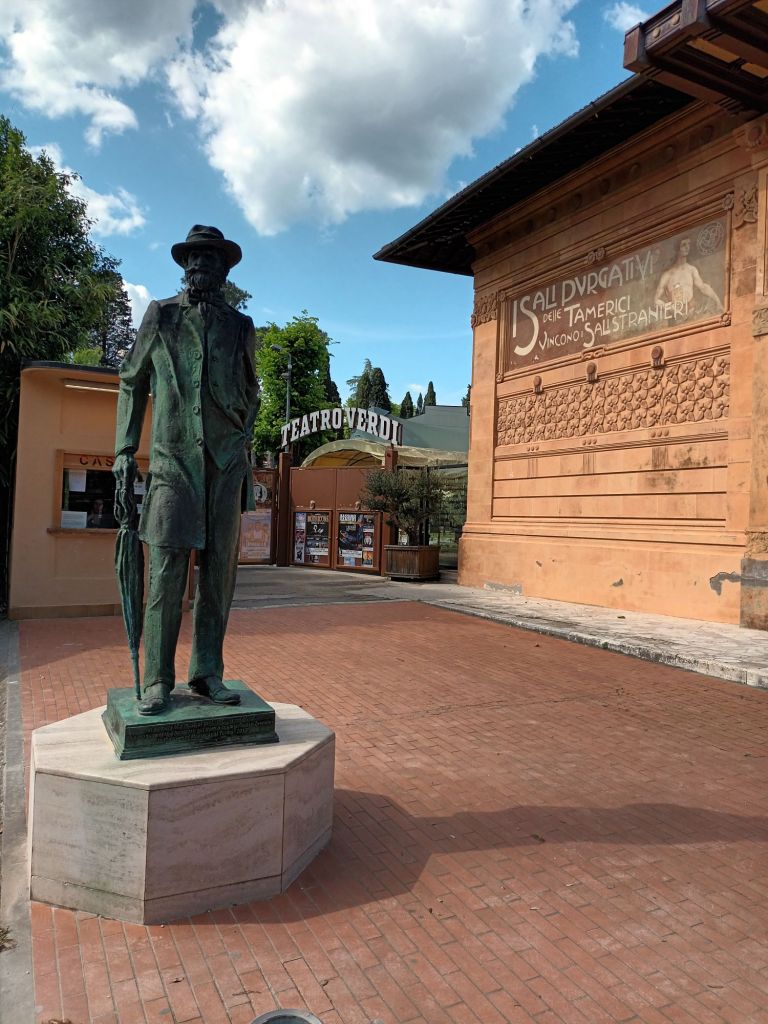
Some of the spa buildings are being restored, and you can “take the waters” between 9 am and midday – not that we shall ever be around then!

Dinner was better than I expected, a four-course meal with a buffet of vegetables and salad if you wanted to make it a bit healthier, and bottles of wine and water on the tables.
We had Night Prayer in the Meeting Room on the 4th (top) floor, access from the 3rd via a metal fire escape or a very small lift. This was to be a nightly event, though the time varied.
Saturday 11 May: FLORENCE
Our local guide for the day, Barbara, joined us for the coach journey, and gave us a summary of the history of Florence, with just the right amount of detail for my taste. In preparation for the pilgrimage, I had looked up the dates of some famous residents:
Dante Alighieri 1225-1321
Catherine of Siena 1347-1380
Leonardo da Vinci 1452-1519
Macchiavelli 1469-1527
Michaelangelo 1475- 1564
The 1290s were a golden age for building splendid churches, to put the city on the map. The population at that time was about 100,000.
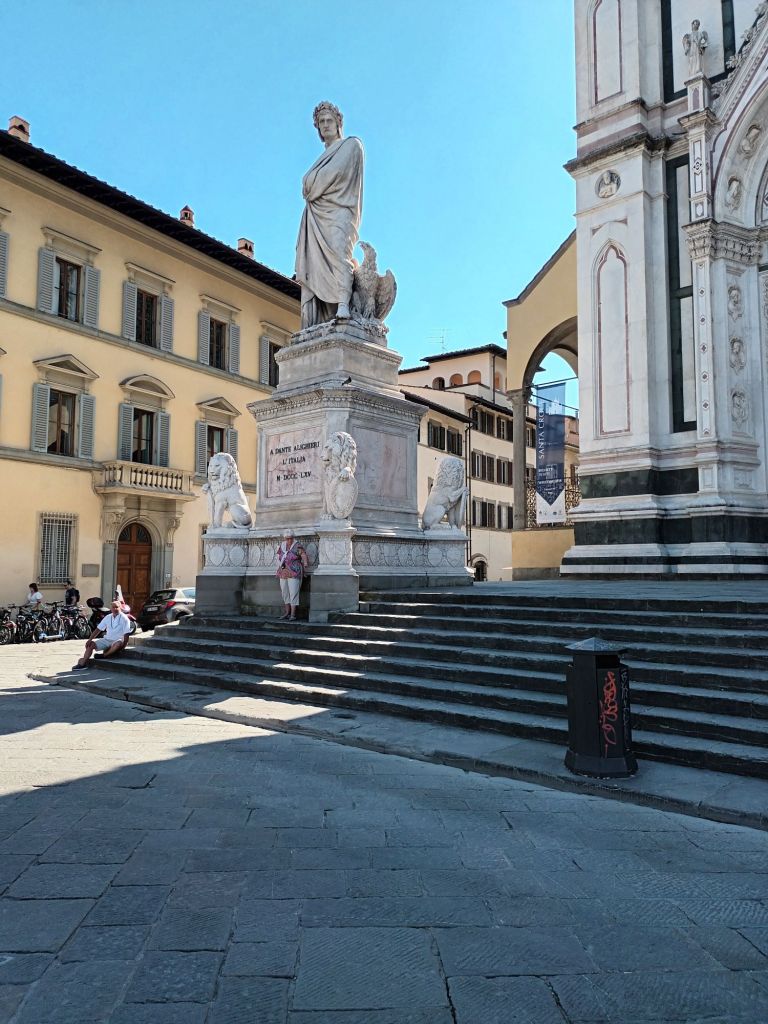
We walked in past Santa Croce, the Franciscan church, with a statue of Dante outside and an empty tomb within.
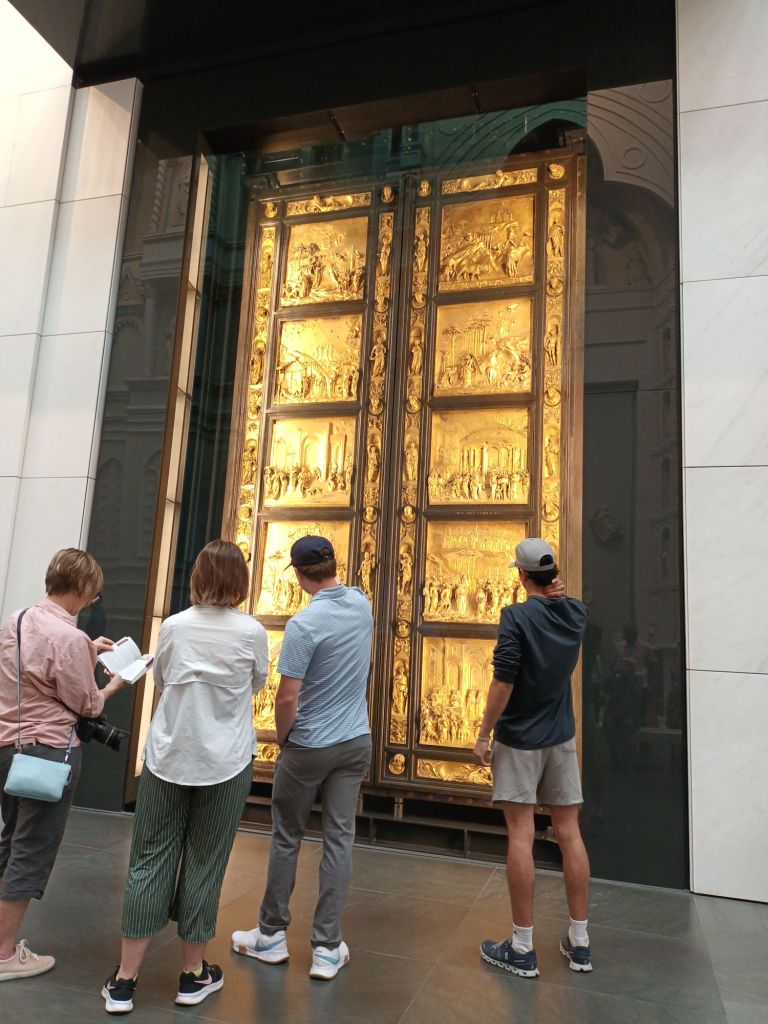
Our Cathedral visit began with the Museum, housing the huge doors engraved with elaborate scenes.
One floor up there were facsimiles of stones carved to represent biblical themes, including Cain’s descendents Jabal, Jubal and Tubal Cain (Genesis 4:20-22).

After that, I lost interest, and was longing to get to the Cathedral for a quiet sit down. But it was not to be. I did break away from the commentary in the crypt, where there were some chairs in front of a simple altar. In the Cathedral itself, we stood in a queue moving forward slowly to the place under the dome where we could gaze up at the frescoes and take photos, and back again. I started singing Taize chants under my breath, because that’s something Pilgrims do. Then on to the Baptistery.
For lunch, Barbara recommended, and led us to, a cafeteria, where 8 euros bought two plates of vegetables and a bottle of beer, just right for a hot day.
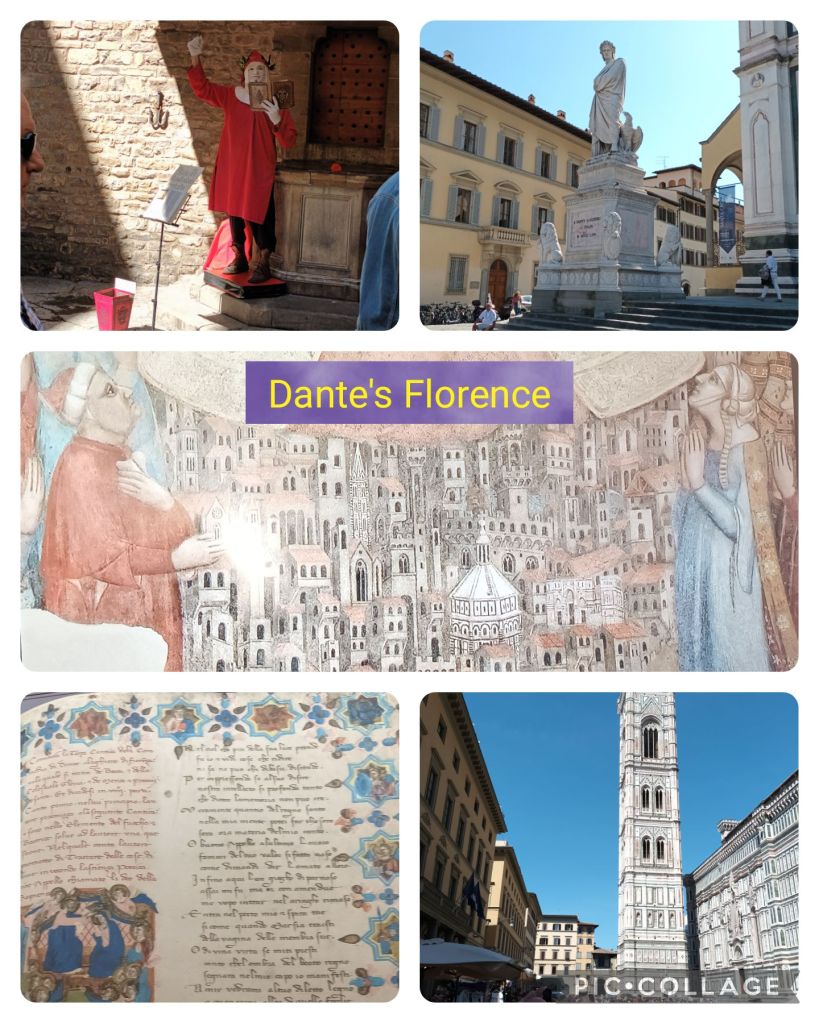
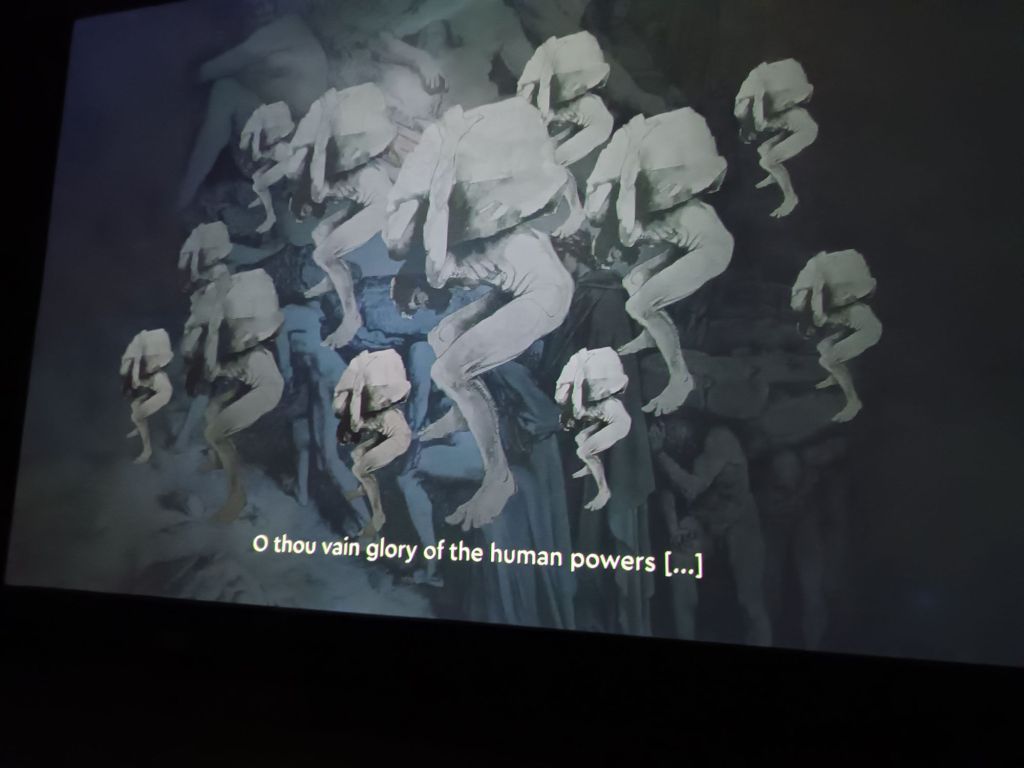
Some people had tickets to visit one of the major galleries , bought online either in advance or with the help of a local guide. I had decided to devote the afternoon to the Dante museum, and, should time allow, other places on a Dante walk I found in a guide book on Kindle. This was a good choice, with much time spent sitting and watching a video with an actor reading extracts from the Divine Comedy with English subtitles.
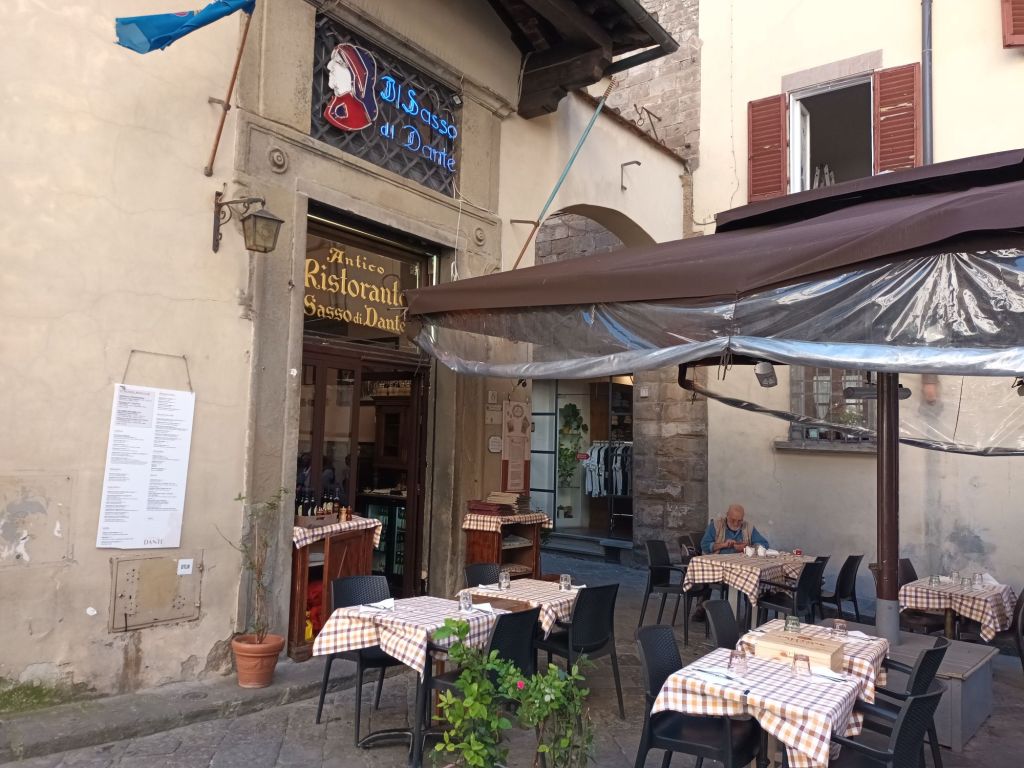
After that I visited the Badia Fiorentia, then an Abbey, where Boccaccio lectured on the Divibe Comedy. The church there is still in use, and there is a lovely cloister. Finally, and hardly worth the effort, to the Sasso di Dante, Dante’s stone, where Dante used to sit outside the Cathedral. Now there’s just an inscription on a wall (not shown in the photo), and the name of a restaurant.
I rejoined the group outside the Palazzo Vecchio, near a replica of Michaelangelo’s statue of David, to walk back to the coach.
Sunday 12 May, SIENA
A much earlier start today with breakfast from 6.45 and departure 7.45.
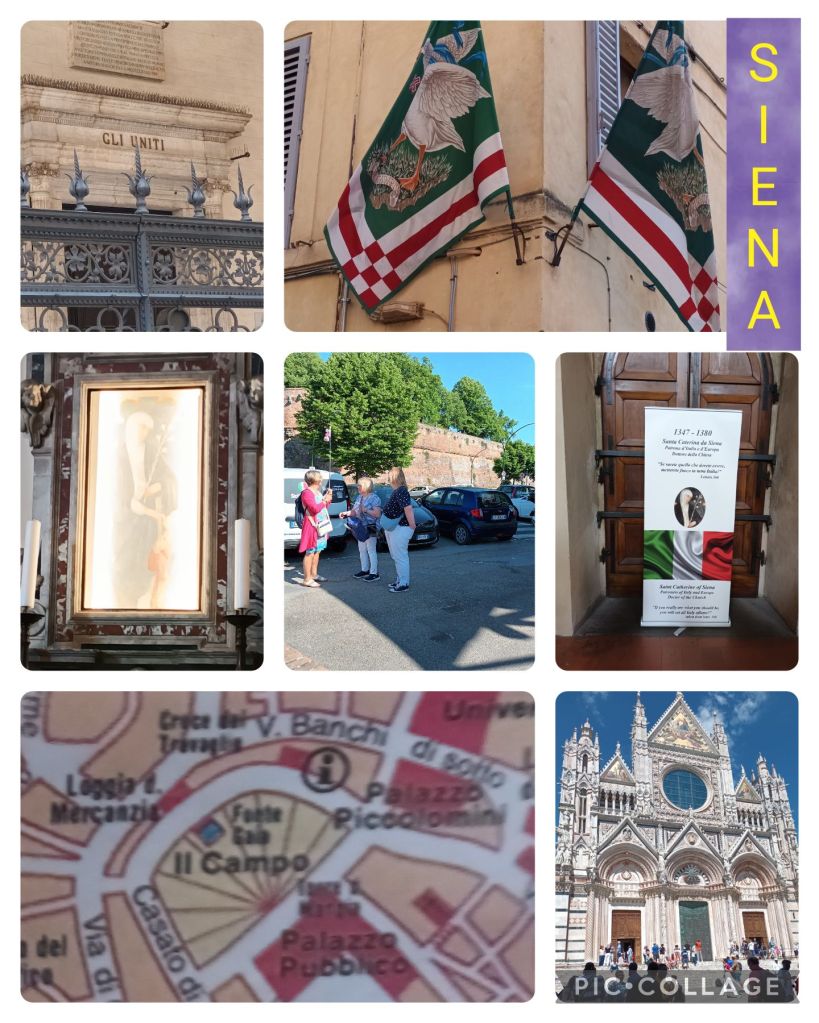
The coach dropped us off by a fortress, and we passed a flower market on the way to San Domenico, an enormous brick church. Children were arriving for their First Communion service, and it seemed strange to be entering the church as tourists on this important day of their lives. However, we did, and prayed together by the relic if St Catherine’s head, her body being buried in Rome.
Then to the Sanctuary of St Catherine, remodelled from her family home. I imagined her as a little girl running up and down the steep stone steps to her bedroom, now an oratory. There are scenes from her life, including two showing shocked reactions of her father finding her at prayer, and her mother seeing her cutting off her long hair.

I think it was Pope Pius II who declared her a Saint, or did he just beatify her? In more modern times, she was proclaimed co-patron of Italy, then of Europe, and finally a Doctor of the Church. Not bad for a barely literate woman who gave the popes of her day a hard time!
We started running into celebrations by the Oca (Goose) district, winners of last year’s Palio, but eventually found a coffee shop where they opened up the seating area for us. I succeeded in ordering a coffee-flavoured ice cream instead of a drink. Then we walked down to the Campo to hear more about the Palio, which brought back memories of my previous visit to Siena some 50 years earlier, when we lost my stepdaughter Imogen in the crowds, failed to order an evening meal, and I tore up a 5000 lire note in frustration. Later I had to stick it together with sellotape to buy petrol.
Lunch was in a pleasant restaurant, with the atmosphere of a wine cellar. Then on to the Cathedral. Our local guide, Francesca, told us about the remarkable pictures on the floor (not mosaic; a sort of marble marquetry) celebrating Wisdom and other themes. I found them disturbing, and wanted to sit and pray. Instead, we were ushered into a queue to walk round the Piccolomini library with its huge murals celebrating the life of someone I’d never heard of (it turned out to be Pope Pius II, born Aeneas Piccolomini) while Francesca gave a commentary from outside the chapel.
After that, the group was dividing between those who wanted to go to the museum, and those eager to climb lots of stairs to a high-level walkway, part of a never-completed extension to the Cathedral I did neither, but sat and prayed for a bit to calm down, then visited the Cathedral bookshop to buy a card for my friend Mick’s Confirmation next Sunday.
Monday 13 May: LUCCA
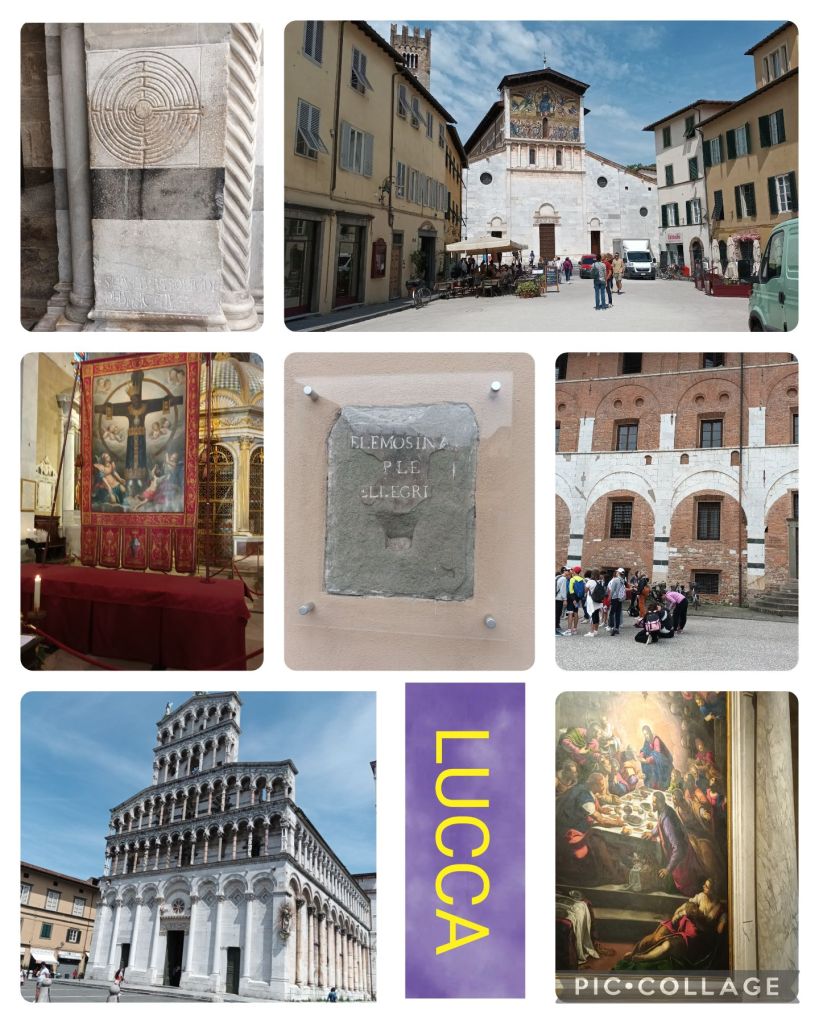
A quieter day, after the very crowded (in both space and time) cities of Florence and Siena. Lucca Cathedral didn’t object to backpacks, and provided stamps for the Pilgrim Passports Michael had made for us. Unlike most of the places we are visiting this week, Lucca is on the Via Francigena, though I wouldn’t have guessed it. The middle picture in the collage shows an almsbox collecting money for (and possibly from) pilgrims, outside the medieval pilgrim hospital.
Apart from walkers on the Via Francigena, the main focus of pilgrimage is a crucifix the Volto Santo. Tradition says it was carved by Nicodemus. Carbon dating says 8th century, but it may have been copied from an earlier one. It’s currently under restoration, so all we could see was the banner in the collage.
We also saw a Tintoretto painting of the Last Supper, with a woman nursing her baby in the foreground (bottom right). Michael led us in prayer before we left to continue the tour, passing the church of San Frediano, an Irish pilgrim who was kidnapped by the locals and forced to become their Bishop. Santa Zita, friend of the poor, is buried in the church.
The guided tour finished at St Michael’s church. At last, plenty of free time. Shonni and I walked round the city walls, and then discovered a Mexican tapas bar for an 8 euro lunch. Then back to St Michael’s, to wander round the church and meet the group to walk back to the coach.
On the way back to the hotel, we stopped at the Passionist Sanctuary of St Gemma Galgani another friend of the poor. (The following day, we would see her picture alongside Mother Teresa in the church of St Francis in Pistoia.) The priest gave told us her story in Italian, which our guide translated, though I’m afraid I nodded off. He then showed us a room with her clothing and other relics.
We were back in Montecatini with free time before having our own Eucharist in the meeting room at 6.45. (Michael had tried to arrange for this in at least one of the churches or chapels visited en route, but they withdrew on discovering that we are Anglicans.)
We ate in a restaurant that night, a change from the hotel.
Tuesday 14 May: Serravalle to Pistoia
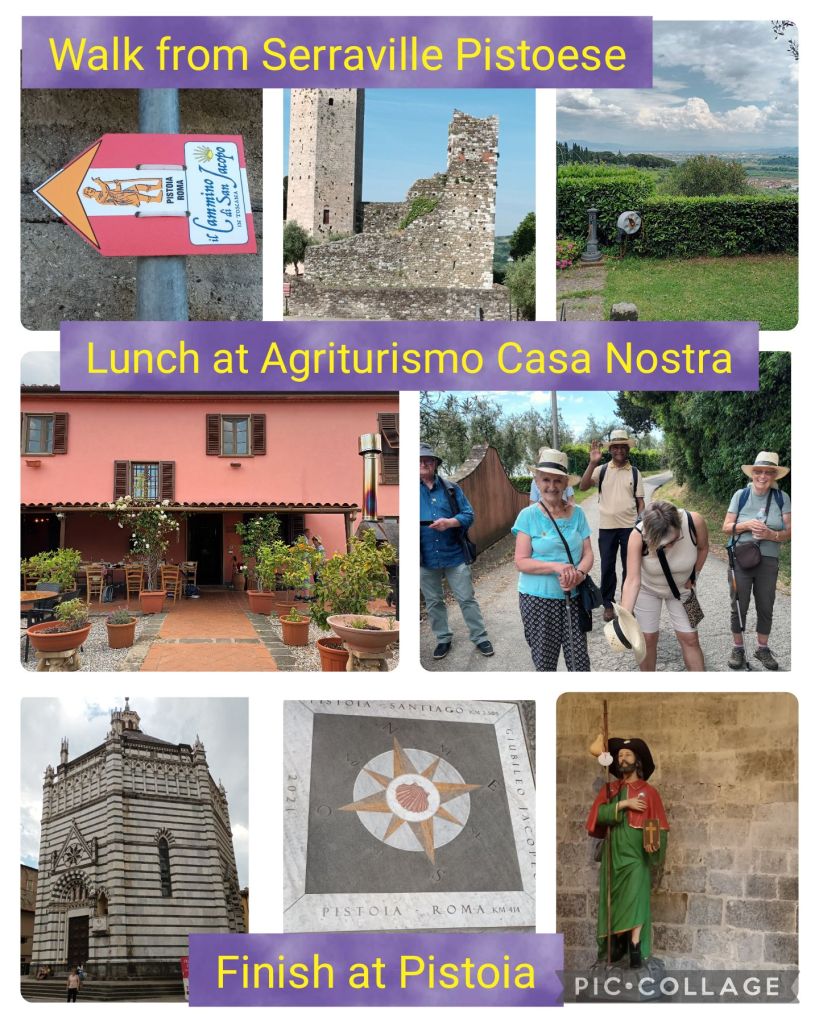
The first of two days walking on St James Way. We met our leaders, Marco and Alessandro, and saw the sights of Serravalle Pistoise: the town hall for stamps and toilet, the church and two fortresses depending on which city they were fighting at the time.
Then down the road, which got noisy as we approached the valley, before a grassy path alongside a field. This was quite short, and ended with a bit of a scramble up the bank. The next stop was for water out of a tap, with a choice between still and frizzante. Soon we left the road for the woods and a steep climb up. A very few muddy stretches where we could see hoof marks, which Alessandro identified as a wild boar’s sow and piglets.
Up the road again, and passed a couple of agriturismos and a disused church before our lunch stop, Casa Nostra. Everything they served had to be produced locally: bread, cheese, ham and especially wine. The vegetarians had the best deal, with a special platter of cooked food replacing our salami. A straw hat each was included. The host pointed out where, on a fine day and with good eyesight, we could have seen Florence in the distance.
Two Pilgrims decided to take a taxi. The rest of us set off and came to a former Franciscsn Monastery, now closed because the floor collapsed and repairs would cost too much. Here we left the road and came to a grassy track downhill, with some Stations of the Cross in various stages of disrepair. From the top, we could see Pistoia, where we were going, with the dome of the Church of St Francis more prominent than the Cathedral.
We visited both: St Francis for a quiet sit down, and the Cathedral to meet a priest who showed us his treasures, including a reliquary containing a piece of St James’s ear as well as other relics. Finally he pointed out a statue of St James at the very top of the frontage, and told us that the fire brigade come with a ladder each year to dress the Saint in red for his feast day on 25 July. On the ground, there was a picture of a compass, new this year, and the distances to Rome and Santiago.
Wednesday 15 May: PISA
We were late leaving Montecatini, which had the advantage that we were still in the coach for a heavy rain shower. Today is the first day we’ve had any rain, and it had almost stopped by the time we got off in Pisa. However, we were still approached by gypsies trying to sell us ponchos and umbrellas.
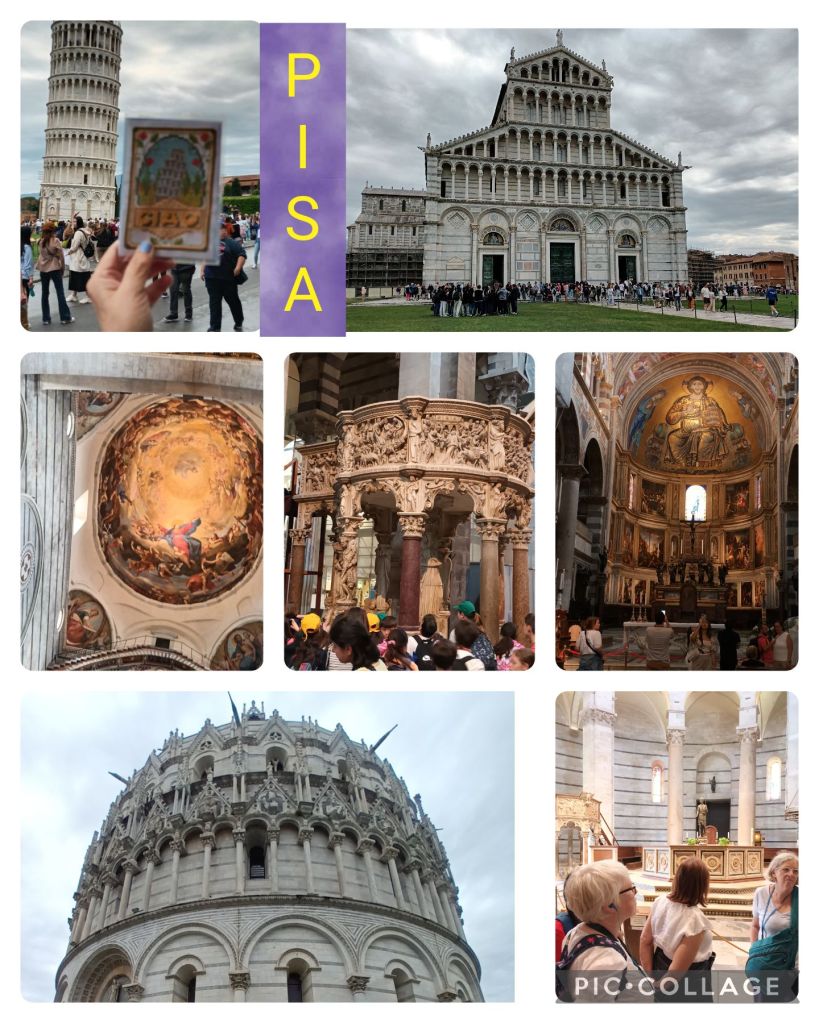
Walked through streets busy with huge groups from cruise liners, then among market stalls, with those of us who had been here before commenting how tacky Pisa had become. We met our guide, David, at the Field of Miracles. I tried to take a photo comparing the cross-stitch cover of my notebook with the real leaning tower, but the light wasn’t good enough.
On entering the Duomo, my first thought was “This looks like a Cathedral!” Or at least like the nave of a cathedral, with a smiling Christ’s Pantocrator blessing us from the east end.
Also remarkable, both here and in the baptistery, are two large pulpits by father and son. The one in the Duomo is really Over The Top, with marble pillars and classical sculptures so full of detail that I wonder if anyone paid attention to the words spoken above their heads.
The tower was designed to house the Cathedral bells, and still does. The lining was discovered early on, and wars delayed its construction. In recent years it has been stabilised and corrected, so that it now leans only 3 degrees not 5, and should last another 300 years. Which is more than can be said for the skyscrapers on Canary Wharf.
After a four-course lunch with liberal helpings of spinach, I failed to get a stamp for my passport. At the book ship, they said, “Next door” but next door turned out to be a dreary office building and I didn’t believe them. Later I found out that I should have persevered.
Back to a coach, for a surprise.
CERTOSA DEI CALCI
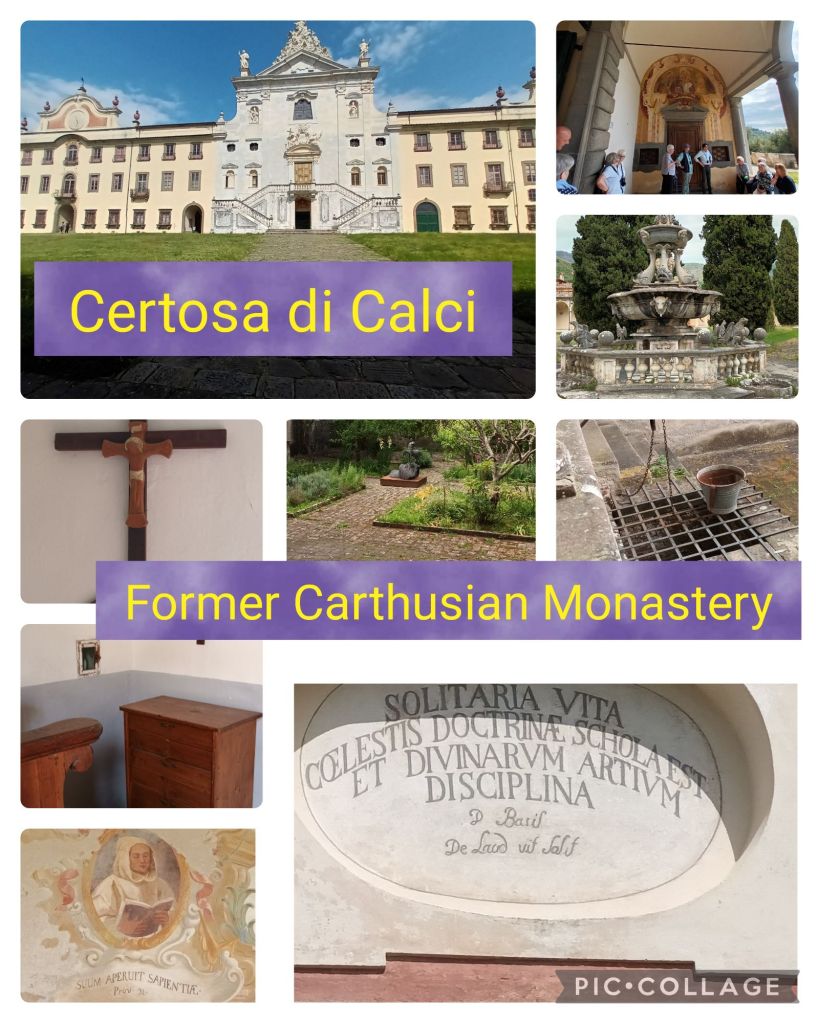
All we’d been told in the itinerary was that we would visit a museum in a quaint village. It may have been quaint; we didn’t see much of the village. And it wasn’t just any old museum, though there was a Natural History Museum next door. Instead, we were visiting a former Carthusian Monastery.
We were amazed at the cell of a choir monk, where he spent almost all his time in solitude and silence. Not the equivalent of a student bedsit, but a suite, including a private garden and his own well. He would have eaten there, food passed through a hatch, except on Sundays feast days and other special occasions when all would come to the refectory. Two pictures there show what it might have looked like. Here’s one of them:

The “laborare” part of the Benedictine rule was carried out by lay brothers, who had less luxurious accommodation.
Thursday 14 May: Pescia to Montecatini
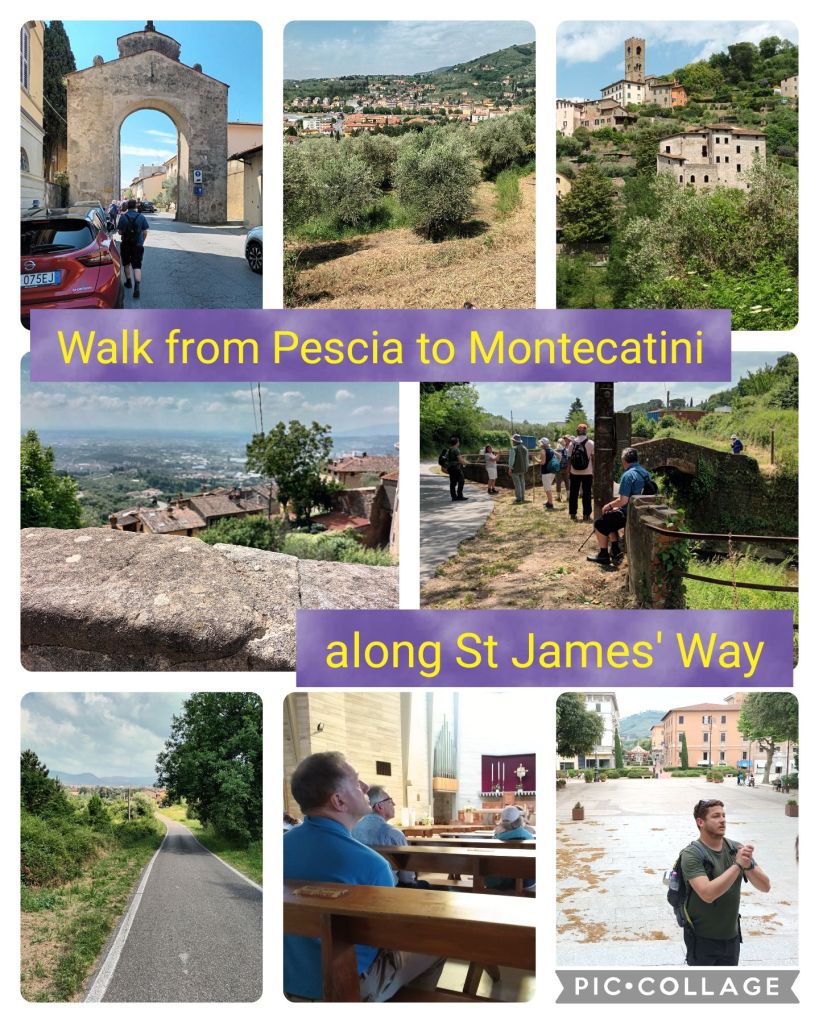
The excitement of a train journey! But it only lasted about 5 minutes, although we had an 11 km walk back to Montecatini. 14 of us walked the whole way, 5 came to see Pescia and returned by train, and the others stayed in Montecatini.
We left the town, famous for its flower market and for Raphael’s Madonna del Baldocchino, returned to the place for which it was painted (further research needed!).
We climbed a grassy track by a thicket of bamboo, with views of the town spread out below us, and the village of Uzzano Alto above. At one stage, I was on all fours, and grateful for a hand up from Alessandro for the penultimate step up to the road.
We skirted the village before taking another footpath, through woods steep and narrow enough to take out my walking pole and sing under my breath:
“Not for ever in green pastures do we ask our way to be,
but the steep and rugged pathway may we tread rejoicingly.”
I was glad to arrive at a (redundant) church (SS Bartholomew and Sylvester) and sprawl on the grass waiting for the last to catch up. Then on to the next church, St Andrew, also closed but there was a pilgrim stamp in a box outside. The ink pad was dried up. I tried to refresh it with water from my bottle, but the stamp was faint and blurred.
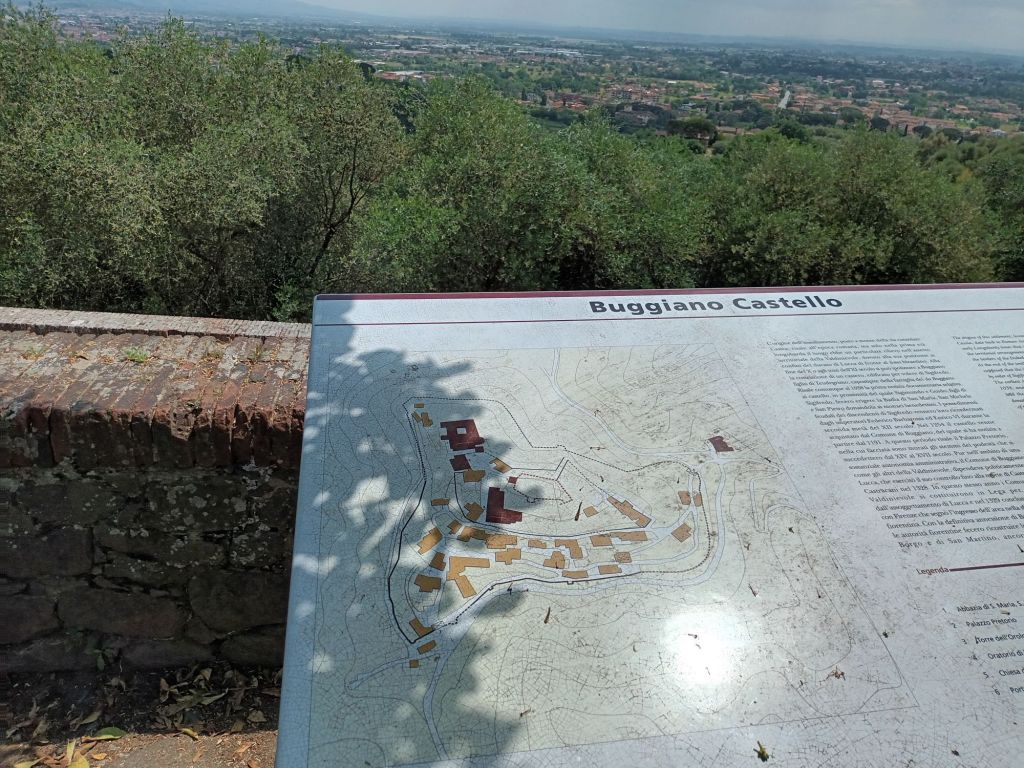
We could see Buggiano Castello, where we would stop for lunch, above us, but we had to go down and cross an old bridge before climbing again. We skirted the settlement, probably Roman according to the display board, and arrived at the restaurant, where we found six elderly men sitting round a table. We wondered if they came here every Thursday to get away from their wives. However, they were friendly, and interested in our walk.
It was just as well we were under cover, as the only rain of the walk was soon beating down on the roof. After a more than adequate lunch, the rain had stopped, and now it really was just a gentle stroll downhill, along the road to the valley and the busier road into Montecatini.
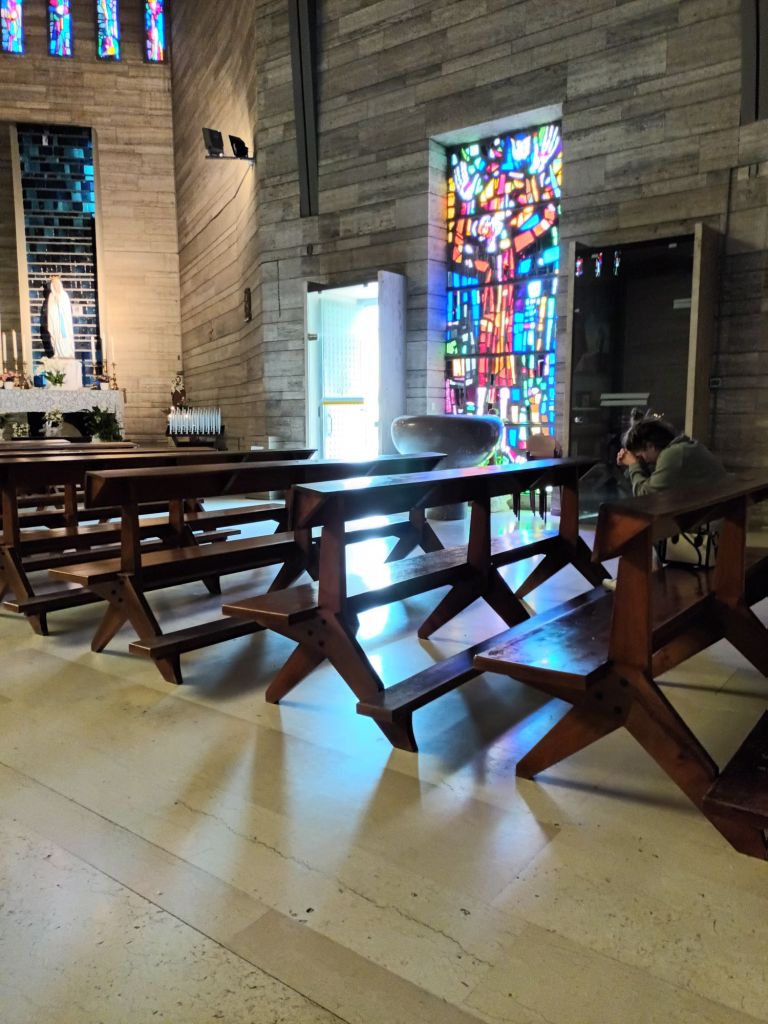
Alessandro phoned ahead to the church to ask if they had a stamp for our passports. It was a wonderful official end to the walk, sitting in this very modern church with stunning stained glass windows, joining in a final prayer, having our passports stamped in the sacristy, and leaving for a final hug each from Alessandro. He was a wonderful leader, and I wrote my notes with a pen from his company, Trekking Toscani.

That evening, we all had another train ride, up the funicular railway, sometimes at an incline of almost 40 degrees, for our farewell dinner, where I got to know some people I hadn’t really talked to so far, and exchanged ideas about why this has been a pilgrimage.
And so to pack. Home tomorrow.
 emeritablog: life after work