I am working my way through Africa: the north coast and some bordering countries from Tunisia to Egypt, then down to the Horn of Africa and across to South Sudan. By the time I reach South Africa I shall have read books from about 20 countries in Africa, roughly half the total.
To keep the cost down, I am mostly borrowing the books on Kindle Unlimited. Searching for the name of the country in Kindle has brought some treats and surprises. Sometimes my first choice for a country turns out to be unreadable, or not really set in that country, and I look for an alternative.
For a complete list so far, see the link in my previous post.
This should really come before the post below, as I was in Cornwall from September 2-8 and in Cumbria from September 16-20. However, I am only just getting round to blogging it.
This “new 125 mile route” is a composite of parts of three established paths: the South-West Coast Path and two cross-country routes, the Saints Way and St Michael’s Way, with detours to places of particular Celtic interest. It has been developed by Revd Nigel Marns, and the guidebook was a family production. Nigel and his wife Penny led the walks and worship, so we heard much about the process of making the way and some of the people he met.
We stayed at Epiphany House in Truro, and were transported by minibus to and from our five walks, sometimes more than an hour’s drive away. A previous group had walked continuously, sleeping on church floors, and Nigel and Penny are looking for more overnight possibilities for individual walkers and groups.
Prayers by a Celtic cross
We usually walked about 6 miles, visiting hospitable local churches and Celtic crosses. The first walk ended at St Michael’s Mount – perhaps this should have come last, but the tides dictated otherwise – and the last at the ruins of St Pirin’s Oratory, surrounded by concrete walls to preserve it from the sands. The latter is not open to the public, but Nigel had the code for the padlock. As we were singing about St Pirin’s four-legged friends, several dogs took advantage of the open gate to come and run round inside.
Inside the Oratory before the dogs arrived.
Another place of interest, also on the last day, was a holy well surrounded by a golf course.
One of our group took every opportunity to get his feet wet
The guide book is beautifully presented, and so is the little booklet which functions as a pilgrim passport, with wildlife line drawings on the background of each page.
We also visited Truro Cathedral to look at the painting of the Saints of Cornwall.
This is the second of two weeks of pilgrimage this September. I have yet to blog the first one, on the Cornish Celtic Way.
I arrived at Swarthmoor Hall on Monday, met my fellow-pilgrims, and was introduced to the week by our leaders Bill and Sylvia. Bill has been the Warden here, and reckons he has climbed Pendle Hill 16 times.
I am the only non-Quaker in the group, and most of the others seem knowledgeable about Quaker history.
Tuesday to Thursday begin with breakfast, then off in the minibus to significant places, with picnic lunch, returning in time for an evening meal and finishing the day with the Epilogue, a short meeting for worship, at 9 pm.
On Tuesday, the first stop was Clitheroe Meeting House, a modern white building which was previously a restaurant. Unfortunately my attempts to take a photo on my phone were unsuccessful. The Meeting moved there from a cold and damp building some way out of town two years ago, and have doubled their membership since then. Two members, Wendy and Ben, greeted us. Ben placed the key year of Fox’s mission to the Northwest in a social historical context, explaining the disillusion with the established church and the prevalence of Seeker groups eager to listen to what he had to say.
We drove along country roads to a track leading towards Pendle Hill, which Fox climbed on his arrival. I am a bit confused about whether his vision of a crowd of eager followers came at the summit to which he had struggled “with much ado” or in the pub afterwards. Today there is a good path like a stone staircase for the 200-metre ascent, and a wider track of rather loose stones for the descent.
Eight of us climbed the hill and had lunch followed by a 15-minute meeting for worship just below the trig point. The latter was terminated with a loud “Baa” from an intrepid sheep.
Back in the bus, we drove to Settle, where we visited the Meeting House, which was the first place of worship in Settle (the parish church being down the road in Giggleswick), and were surprised by three stuffed orangutans in the garden.
About half the group met in the Friendship Room after supper, and talked, mainly about why we had come and how we felt on the top of Pendle Hill. This went on until it was time for the Epilogue.
Wednesday was a slightly shorter day out, beginning with the Quaker graveyard and Meeting House at Briggflatts. To my amazement, three of the group were looking for particular graves: one for members of his family, one for a former l popWarden of the Meeting, and one for the Quaker poet Basil Bunting. The meeting room dates back to the 17th century, and has an exhibition of pictures and Bunting’s poems in the gallery. Alan, a Friend who has recently moved to the area, told us about George Fox’s visit to Briggflatts.
We then visited the church at Sedberg, where Fox gathered a crowd of listeners at the Hiring Fair and had an argument with the priest, before proceeding to Firbank Fell, where he preached to about a thousand people from an impressive rock. Not much walking was involved, as the site is now close to a road. Two horses tried to join us for lunch.
Then on to Kendal to visit the Quaker tapestry, a project resulting in 77 panels illustrating different aspects of Quaker life and history, which was completed in 1995. We spent an hour and a half here, and then opted to return by the “scenic route”, stopping to admire a view over Lake Windermere.
Thursday was an even shorter journey, to Lancaster where the Meeting House provided a room with tea, coffee and biscuits, and toilets, but none of the warm hospitality we had found in the smaller meeting houses of the previous days. This didn’t bother me, as we weren’t there long enough for a talk or worship, but the others were shocked and disappointed.
The purpose of going to Lancaster was to visit the castle, where George Fox and Margaret Fell (later Fox) had been imprisoned on various occasions. The castle was a prison until 2011, and houses civil and criminal courtrooms, the latter still in use. Otherwise it’s a museum – guided tours only. The tour guide was excellent, lively, informative and amusing, and a senior colleague met us at the end of the tour to answer some questions she couldn’t.
Returning to Cumbria, we visited the early burial ground where Margaret Fox and 226 other Friends are buried. No tombstones were allowed there at the time, so there is not much to see, but great views of the coast from across the road.
Entrance to the burial ground
Returned to Swarthmore Hall at 3 pm. I filled in the half hour before tea exploring the gardens, including the labyrinth. At 4, Susie, the Quaker in Residence, led a tour of the Hall. It had passed out of the hands of Margaret’s family and allowed to decay, but bought back in 1914 by a descendent who restored it, adding woodcarving in the style of the original panels. She left the Hall to her nephew on the understanding that he would pass it on to the Quakers which he did in 1954. Interesting furniture and artefacts, some associated with Fox, others of the period.
The back of this chair is hinged, converting it to a table.
There are some amazing colourful quilts, including this one with a central panel showing the lion and the lamb lying down together.
The Lion and Lamb motif on George Fox’s bed
On the last morning, we walked to Swarthmore Meeting House, donated by George Fox in readiness for the time when Quakers could not worship at the Hall.
Swarthmore Meeting House, from the Gallery.
When the shutters to the passage and gallery are open, there is room for 120 people.
Back to the Conference Centre for our feedback and lunch before going our separate ways, Bill and Sylvia with a banner for the day’s Climate Strike in Ulverston.
Today I finished writing up my time in Spain – as a chaplain to pilgrims in Santiago, and as a pilgrim myself from Toledo to Avila – in a new page on the main menu, Pilgrim Priest. This includes the last few posts – I have now discovered how to show photos the right way up! I had kept a diary for the first ten days in Santiago, but not for the last eight, so that part is sketchy, but it is useful to have a record.
Now for the more difficult part: the inner journey.
The day began well. Breakfast, with orange juice and ample coffee. The landlord had put on a DVD showing the sights of Avila, and it was a lovely morning for sightseeing, sunny but cool. We walked over the bridge, along the wall, and through the old town, and found our way to the cathedral, arriving just before 10 when it opened. Being among the first visitors, we found it a quiet and peaceful place, unlike Toledo the previous Saturday afternoon. I prayed my way round the cloisters, and then got lost in the museum and had to ask for the way out back into the cathedral.
Then to the tourist office for a better map, and along the wall to the church at St Teresa’s birthplace. A side aisle leads to a room with the bed she was born in. We discovered that there would be a Pilgrim Mass at 13:00, and went back to the cathedral plaza to look for souvenirs. I found a fridge magnet with the words of Teresa’s prayer Nada te turbe, so that I can sing the Taizé chant without lapsing into Swedish, and a small icon of Teresa, and Gordon bought the DVD we had seen at breakfast.
On the way back for the mass, we visited an interpretation centre with displays about mysticism. Although everything was in Spanish apart from an introductory guidebook at the front desk, there were striking visual images, and it was fun working out what they meant: a large, rough net; a tree hanging upside down, with bare branches on the lowest floor and ribbons with the names of mystical philosophers one floor up. We never did find the roots of the tree.
We joined the queue waiting to enter the church for the mass. Someone was singing (probably recorded) a different setting of Nada te turbe until the priests entered, and we were given prayer cards for a prayer to be said together after communion. It was wonderful to be part of a large worshipping community.
Then lunch outside a hotel on the city wall. The Menu del Dia was only available Monday to Friday, so we shared Gordon’s choice, a salad with goat cheese and quince dressing, and mine, white beans and pork. Then Gordon went back to the hotel, and I visited the Basilica of St Vincent
Tomb of the martyrs at the Basilica
then Teresa’s two convents, the Incarnation and San José, when they opened for the afternoon at 16:00.
The original chapel at the Convent of San José
They were both outside the old city, and I hurried back to meet Gordon at the place where Teresa and a little brother were retrieved by their uncle when, as small children, they ran away to fight the Moors. This is close to our hotel, where we returned before seeking a supermarket for our journeys tomorrow and a restaurant for more tapas. Then a final Teresian evening prayer, and packing.
Gordon left for the bus station at 7 this morning. I shall go to the 11:00 mass at the cathedral, and have booked an afternoon train to Madrid and checked in to my flight to Santiago.
Both days have involved walking up steep hills to a named pass where the Camino crosses the road, and walking through a herd of cows. Yesterday in the rain, today in sunshine with the wind at our backs.
Last night was the only occasion we stayed in a pilgrim refuge – in this case, a room with six bunks in a building also used as a health centre and for a fitness class, in the village St Bartolomé de Pinares. I saw from the guestbook that it was well used; two people had stayed each of the two preceding nights. We ate a variety of tapas etc. in the village, and went to church – a very large church for such a small place.
Today we arrived in Avila, our destination, where we shall stay two nights.
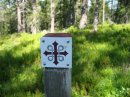
After two days of frequent encounters with the main road N403, yesterday was delightful. For much of the time we were following Via Pecuria, which, judging from its logo, was an old drovers’ road, and is still used for taking cattle to summer pastures – we saw the evidence, but not the cows.
We walked through woodland, and up the Hill of Three Crosses, where we stopped for lunch. I hoped to see three crosses at the top, but there weren’t any. The Camino goes down a steep firebreak, but we followed the alternative suggested in the guidebook, a wide bumpy track. If the roads were like this, or worse, in Teresa’s day, I understand why her coach journey from Escalona to Avila was uncomfortable.
Much cooler today – clouds, wind, altitude as well as plenty of shade from the trees and some enormous rocks.
We had booked a self-catering apartment for 80 euros, and saved some of that by making our own dinner. As we were finishing at 6:30, we heard church bells and guessed there might be a Mass at 7. We got there in time. Large congregation for a weekday, and very enthusiastic Spanish priest.
Toledo was the site of the fifth convent founded by St Teresa, 450 years ago. There will be a special concert in her honour in the cathedral on October 19, but we shall have gone our separate ways by then, Gordon to stay with a friend in Malaga and I to return to the pilgrim ministry in Santiago.
The train I meant to get from Madrid was full, so Gordon reached the hostel an hour and a half before me. Our only sightseeing together was the Cathedral, where we spent an hour waiting for the market to reopen after the siesta, and later returned for Mass.
It gives the impression of a lot of separate spaces. Even the sanctuary is separated from the choir, with empty space between the two. The sacristies have been converted into an art gallery, with a set of El Greco portraits of the apostles. Most of the chapels were closed by iron gates, and the one where the Mass was celebrated was in three parts: a fenced-off area within the main cathedral space with its own street entrance for worshippers only; then through the glass doors to a quieter space for prayer; and finally, heavy iron gates can be opened to give access to the final chapel with a double row of pews on each side (and decent kneelers)!
There was plenty to see: much golden baroque, the carvings on the sedillas in the choir, and a huge mural painting of St Cristobal (Christopher) carrying the Christ child. Of course there was a chapel of St James. But, to my joy there was also one of St Teresa.
The Man in the Panther’s Skin, Shota Rustaveli. Medieval classic, supposedly dedicated to Queen Tamar.
Bread and Ashes: a Walk through the Mountains of Georgia, Tony Anderson. Didn’t get very far with this one.
The Lion Queen, Christopher Nicole. Historical novel about Queen Tamar, told through the eyes of an English teenage girl captured by a Georgian rebel king who became the queen’s favourite.
Tour de Armenia, Raffi Youredjan. American Armenian on a cycle tour and possibly search for a wife.
Lonely Planet Georgia, Armenia and Azerbaijan. A hard copy would have been more useful, for maps and useful phrases, flicking back and forth, etc. But this was free on Kindle Unlimited.
The First Toast is to Peace: Travels in the South Caucasus, Stephen Powell. Based on a travel blog from 2014 to 2016, a retirement project.
The Crossing Place: A Journey Among the Armenians, Philip Marsden. Covers the Armenian diaspora as well as the present-day country.
Georgia in the Mountains of Poetry: Peter Nasmyth. Long-term resident’s reflections on the Rose Revolution of 2003 and later developments. Did he found Prospero’s Books?
I tried to find a basic introduction to the Georgian or Armenian language, but the ones I found were not helpful. I could have bought a “Georgian for Survivors” book in Prospero’s Books for 10 lari, which would have given me the alphabet and some useful phrases, but didn’t. The only phrase we learned, “Good morning” in Armenian, sounded like “Barry Lewis”; this was easy to remember, and the locals recognized our attempts to say it.


 emeritablog: life after work